

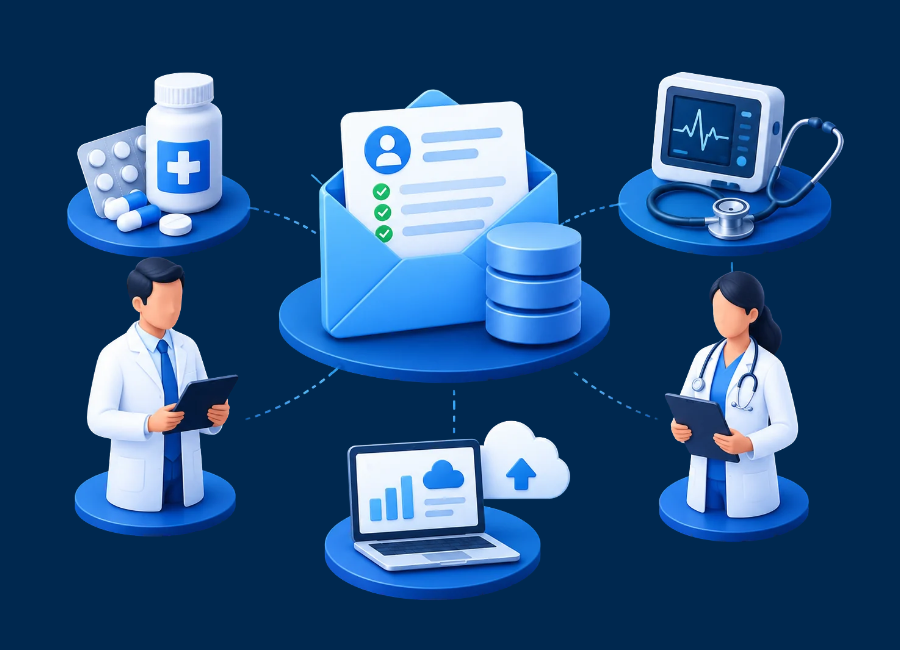
The short answer: a healthcare email database is bought by companies that sell to healthcare organizations rather than to patients. In practice that means pharmaceutical companies, medical device and MedTech manufacturers, healthcare SaaS and health IT vendors, equipment and supply distributors, healthcare service providers and consultants, and the B2B marketing agencies working on their behalf.
What they are buying is professional business contact data: the work email, role, organization and location of healthcare professionals and administrators. It is not patient data, and the distinction is not a technicality.
This article covers who buys this kind of database, what each type of buyer actually does with it, and why the same file supports very different campaigns depending on who is holding it.
What a healthcare email database contains
A quality database goes beyond a list of email addresses. It typically includes professional roles, specialties, organization type, location, facility details, and sometimes direct phone numbers or LinkedIn profiles—allowing teams to segment by who actually influences or approves a purchase.
The most useful distinction is between clinical influence and buying authority. A surgeon may champion a device, while a procurement director approves the contract; a physician may use an EHR, while the CIO and IT team select it.
Pharma: precision outreach at scale
Pharmaceutical teams use healthcare contact data to support drug-launch campaigns, educate prescribers, identify key opinion leaders, and recruit clinical trial sites. Targeting by therapeutic area, geography, specialty, and organization type helps reduce wasted outreach and supports longer, relationship-driven sales cycles.
Common pharma use cases include:
- Announcing a new therapy or indication to relevant prescribers.
- Inviting specialists to medical education, advisory, or speaker programs.
- Identifying potential investigators and trial sites.
- Mapping KOLs and building territory-level engagement plans.
For pharma, however, promotional email is highly regulated. Teams should separate compliant promotional communications from non-promotional medical affairs engagement and follow applicable consent, anti-spam, privacy, and industry rules.
MedTech: reaching clinical champions and buyers
Medical device companies often need to engage multiple stakeholders before a purchase happens: the clinician who will use the product, the department leader who prioritizes it, and the procurement or biomedical team that evaluates it. A segmented database helps device teams book demos, nurture evaluation committees, and run account-based campaigns across hospitals and clinics.
Typical MedTech applications include:
- Product launch announcements by specialty or procedure.
- Demo and in-service scheduling.
- Procurement-driven outreach to hospital buyers.
- Clinical-evidence and training communications.
- Territory planning around high-potential facilities
Healthcare SaaS: selling to complex buying committees
Health-tech and SaaS companies face multi-stakeholder sales. An EHR, telehealth, revenue-cycle, analytics, or patient-engagement platform may require alignment among clinical users, IT leaders, finance teams, and executives. Contact data enables SaaS teams to build account-based campaigns that reach each persona with a relevant message.
High-value SaaS use cases include:
- Targeting hospital CIOs and IT directors for infrastructure-led solutions.
- Reaching practice managers for billing, scheduling, or front-office tools.
- Nurturing clinical leaders for workflow and patient-experience platforms.
- Running ABM campaigns across hospitals, health systems, and physician groups
Equipment and supply distributors
Distributors and suppliers of consumables, instruments and capital equipment use contact data mainly for breadth and territory coverage.
Common uses include reaching procurement and materials management roles, supporting regional reps with lists aligned to their patch, running replenishment and catalogue campaigns, and recruiting new accounts in facility types they under-serve, such as long-term care or ambulatory settings.
Here the valuable fields are organizational rather than clinical: facility type, size, location and purchasing role.
Healthcare service providers, consultants and agencies
- Service providers and consultants, including billing companies, staffing firms, revenue cycle specialists and advisory practices, use contact data to reach practice managers, administrators and executives. Their targeting tends to be driven by organization size and type rather than specialty.
- B2B marketing agencies buy on behalf of all the above. Their practical requirement is different again: they need data that can be re-segmented repeatedly for different clients, and clear licensing terms about what may be used for whom and for how long. That last point catches agencies out more often than any data quality issue.
Use cases by buyer type
The table below shows how the same underlying database supports different motions depending on who is using it.
| Buyer type | Primary use case | Typical target roles | Main segmentation driver |
|---|---|---|---|
|
Pharmaceutical |
Medical education, congress and formulary outreach |
Prescribers, pharmacy directors, P&T committee members |
Clinical specialty and practice setting |
|
MedTech and devices |
Product launch, proctoring, field sales support |
Surgeons, proceduralists, value analysis, supply chain |
Sub-specialty plus facility type |
|
Healthcare SaaS and IT |
Account-based marketing, webinars, long-cycle nurture |
CIO, department heads, clinical champions, finance |
Target account list and role coverage |
|
Equipment and supply |
Territory coverage, replenishment, new account recruitment |
Procurement, materials management, practice managers |
Facility type, size and location |
|
Services and consulting |
Lead generation for operational services |
Administrators, practice managers, executives |
Organization size and type |
|
Marketing agencies |
Campaign delivery for multiple clients |
Varies by client |
Re-segmentation flexibility and license terms |

What changes depending on who is buying
Two buyers can look at an identical database and reach opposite conclusions about its quality, because they are measuring different things.
A pharma team evaluating it will look first at specialty coverage and whether specialty is a structured field or inferred from job titles. A MedTech team will look at whether sub-specialty and facility attributes are populated. A SaaS team will look at role coverage within their named target accounts and barely care about total record count. A distributor will look at geographic density in their territories.
This is why generic accuracy percentages are close to meaningless as a purchase criterion. The honest question is not how accurate the database is in the abstract, but how many records survive your specific filters with the fields you need populated. The method for testing that is the same regardless of which buyer you are, and we cover it in detail in our guide to finding accurate B2B email list providers.
Where MedicoLeads fits
MedicoLeads helps businesses connect with healthcare professionals and organizations through targeted contact data for B2B marketing, sales, and lead generation.
- 14M+ Healthcare Contacts: Reach professionals across specialties and roles.
- 95% Accuracy: Access data focused on contact accuracy.
- 100% Opt-In Data: Support permission-conscious outreach.
- 7-Tier Verification: Multi-level data verification.
- 45-Day Revalidation: Regular contact data reviews.
- 170+ Countries: Target international healthcare markets.
- 40+ Data Attributes: Segment contacts by relevant criteria.
- Flexible Formats: CSV, Excel, and API options, subject to availability.
MedicoLeads helps businesses build targeted healthcare prospect lists for their specific outreach needs. Request a sample to evaluate the data before purchasing.
Conclusion
Healthcare email databases serve a range of B2B industries, but each buyer has a different objective. Pharmaceutical companies focus on relevant healthcare professional engagement, MedTech manufacturers need to reach clinical and purchasing stakeholders, and healthcare SaaS companies often target complex buying committees.
Staffing agencies, marketing firms, insurers, and research organizations also use professional contact data to support business development and targeted outreach.
The best choice is a database that aligns with your audience, provides relevant and well-maintained professional information, and supports responsible data use.
Frequently asked questions
Who buys a healthcare email database?
Companies that sell to healthcare organizations rather than to patients: pharmaceutical companies, MedTech and medical device manufacturers, healthcare SaaS and health IT vendors, medical equipment and supply distributors, healthcare service providers and consultants, and B2B marketing agencies acting for them. The common factor is that their customer is a clinician, an administrator or a healthcare institution.
Is a healthcare email database the same as patient data?
No. A healthcare email database holds professional business contact information: work email, job title, organization and location. HHS guidance describes protected health information as individually identifiable health information relating to a person’s health, care or payment for care. It also notes that identifying details are not automatically PHI, and that a public directory listing is not PHI because it does not relate to health care.
What do pharmaceutical companies use healthcare contact data for?
Typically medical education and congress invitations, formulary and pharmacy committee outreach, clinical trial site recruitment, therapeutic area awareness among relevant specialists, and market research recruitment. Targeting is usually driven by clinical specialty and practice setting. Contact data determines who can be reached; what may be said to them is governed by separate pharmaceutical promotion rules.
How do MedTech companies use a healthcare email list differently from pharma?
MedTech targeting usually needs to reach sub-specialty level and must cover both clinical and administrative roles, because device purchases involve value analysis committees and supply chain alongside the proceduralist. Facility attributes such as hospital type, bed size and whether the setting is an ambulatory surgery center matter as much as the clinician’s specialty.
What should healthcare SaaS companies look for in a contact database?
Role coverage within named target accounts, rather than total record count. Health IT sales are long and committee-driven, so reaching the CIO, the relevant department head, a clinical champion and a finance approver inside the same organization is worth more than a thin spread across many organizations. Account-level completeness is the metric that matters.
Can a healthcare email database be used for account-based marketing?
Yes, and it is one of the stronger use cases. ABM depends on reaching several roles inside a defined set of target organizations, so the database needs reliable organization identifiers and good role coverage per account. Before buying, ask the provider how many contacts they hold at a sample of your actual target accounts rather than how many records they hold overall.
Does buying a healthcare email database make my outreach compliant?
No. Sourcing data and sending email are separate obligations. In the US, CAN-SPAM requires accurate headers, advertisement identification, a valid postal address and a working opt-out honored within 10 business days, regardless of where the addresses came from. Recipients outside the US may fall under stricter consent rules, and regulated promotion carries its own requirements.
How do I know if a healthcare email database is right for my business?
Work backwards from your targeting. Write down the specific attributes your campaign depends on, such as specialty, facility type, role seniority or territory, then ask for a sample built to exactly those filters. Measure how many records survive them with your required fields populated. That number, not the vendor’s headline accuracy figure, tells you whether the database fits.