

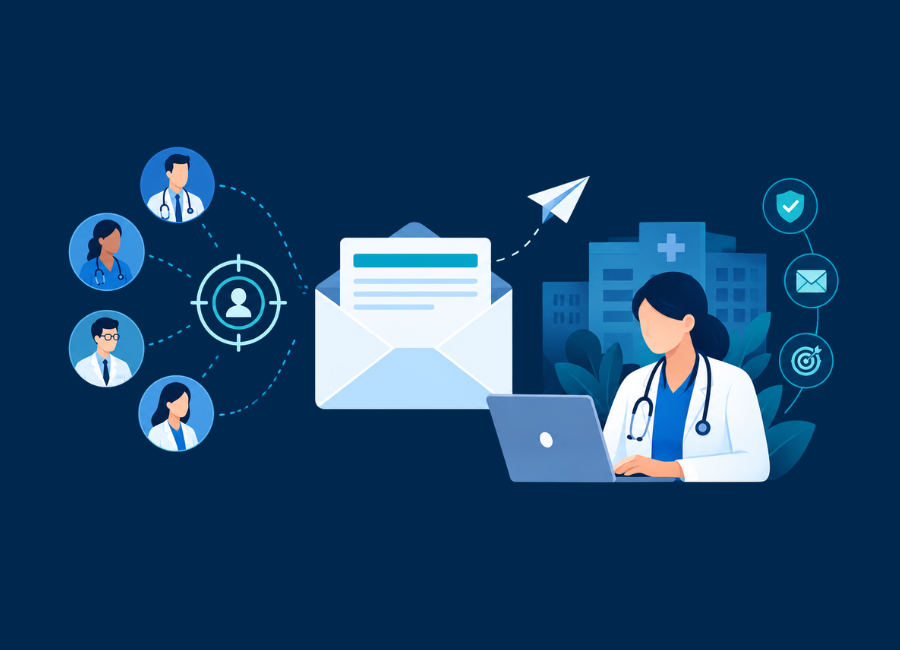
Most teams that underperform at email marketing to healthcare professionals do not have a volume problem. They have a precision problem. Two million records look impressive in a pipeline review, but if many have changed employers or never belonged to the target audience, the campaign stalls before the first reply.
Healthcare is a harder B2B audience than most. Clinicians read email between patients, and titles overlap: a director of nursing at a 60-bed rural hospital faces different budgets than one at a 900-bed academic center. Reaching them depends on accurate targeting, segmentation, personalization, and deliverability working together. For the multichannel picture, see our wider B2B healthcare outreach playbook.
What Is the Smarter Approach to Healthcare Email Outreach?
The smarter approach to healthcare email outreach means sending fewer, better-targeted emails to a verified audience instead of broad blasts to a purchased file. It combines accurate contact data, segmentation by specialty and role, message personalization, authenticated sending infrastructure, and lawful opt-out handling, then improves each campaign using measured engagement rather than assumptions.
Why Reaching Healthcare Professionals Is Different
Standard B2B playbooks transfer poorly here. Reaching healthcare professionals via email starts with the constraints they work under.
- Compressed schedules. Many read email between appointments or on a phone after hours. Long emails and heavy templates lose them.
- Specialty determines relevance. An interventional cardiologist and a family medicine physician share a credential, not a problem set.
- Role is not authority. A physician may influence a device purchase while a materials manager signs it. Practices, IDNs, and systems route decisions differently.
- Geography drives eligibility. Licensure, reimbursement, and formulary rules vary, so an offer valid in Texas may not apply in Ontario.
- Professional versus personal addresses. Hospital and practice domains filter more aggressively than consumer inboxes, and are usually the only appropriate channel.
- Records move constantly. Physicians change affiliations, nurses move between units, pharmacists between retail and health-system roles.
7 Strategies for Reaching Healthcare Professionals More Effectively
1. Define the exact audience first. Write it in one sentence: “U.S. hospital-employed anesthesiologists in facilities with 200+ beds.” That sentence becomes your filter set.
2. Segment by specialty and role. Split the audience before the first send, not after a poor result. One campaign aimed at nurse practitioners, staff RNs, and nurse managers convinces none.
3. Use recently verified contact information. Confirm when the provider last validated each record. Verified healthcare contact data protects sender reputation, because hard bounces damage it fast.
4. Personalize on attributes you can defend. Specialty, setting, and region are facts, and an NPI is checkable against the CMS NPI Registry. Guessing at a clinician’s priorities backfires with experts.
5. Lead with something useful. Evidence summaries, workflow benchmarks, and reimbursement explainers earn attention. Brochures rarely do on a first touch.
6. Fix deliverability before scaling volume. Authenticate domains with SPF, DKIM, and DMARC. Google’s email sender guidelines require senders of roughly 5,000+ daily messages to Gmail to authenticate, keep spam complaints below 0.3%, and honor one-click unsubscribe within two days.
7. Measure at the segment level. Roll-up rates hide the signal. Comparing by specialty, title, and region shows which segments justify more investment.

Segment Healthcare Professionals Before Sending Emails
Healthcare email list segmentation is the highest-impact step in most programs. Useful dimensions include specialty, job title, organization type, geography, practice type, size, and professional interests. Our complete healthcare email marketing guide maps these to campaign types.
| Segment | Example Audience | Relevant Campaign Approach |
|---|---|---|
|
Specialty |
Oncologists in academic centers |
Evidence summaries, trial or registry participation |
|
Job title |
Directors of nursing |
Staffing efficiency, retention, scheduling content |
|
Organization type |
Independent group practices |
Per-provider pricing, short implementation |
|
Geography |
Dentists in the U.S. Midwest |
Regional regulatory updates, local events |
|
Practice type |
Retail vs. health-system pharmacists |
Dispensing workflow vs. formulary and 340B |
|
Organization size |
Hospitals with 500+ beds |
Enterprise integration, security review, procurement |
|
Professional interest |
Clinicians following digital health |
Roadmap previews, pilot invitations |
Even three or four segments outperform one undifferentiated send.
Why Healthcare Email Data Accuracy Matters
Data quality sets the ceiling on everything downstream. Industry analyses commonly estimate that a fifth to a quarter of B2B records lose accuracy yearly, and healthcare sits at the demanding end.
- Invalid addresses generate hard bounces that mailbox providers read as poor hygiene.
- Role changes send a director-level pitch to someone now in a staff position.
- Organization changes route messages to a hospital the clinician left months ago.
- Duplicate contacts inflate counts, distort reporting, and can send the same message twice.
- Outdated professional information, such as a superseded specialty, undermines credibility with a detail-oriented audience.
Verification is the countermeasure. Ask what the process involves, how often records are revalidated, and whether it is automated or manual. Our notes on contact data best practices cover maintaining a list you own.
How to Personalize Emails for Healthcare Professionals
Effective personalization in physician email marketing is contextual, not cosmetic. Merging a first name into a subject line changes nothing; referencing the recipient’s working conditions changes a great deal. Techniques include specialty-specific framing, role-specific outcomes, and segment-built subject lines.
Specialty-specific. Instead of “Improve your practice efficiency,” write “Cut pre-authorization turnaround for high-cost oncology infusions.”
Role-specific. To a nurse manager: “A shift-swap workflow three hospital systems use to cut overtime.” To a CNO: “What nurse turnover cost comparable systems last year.”
Geographic. “New Illinois telehealth documentation rules take effect in January — a summary for dental practices.”
Compliance Considerations for Healthcare Email Outreach
Responsible outreach to clinicians sits under marketing-email law, not patient-privacy law. The distinction matters.
- CAN-SPAM (U.S.) governs commercial email. The FTC CAN-SPAM compliance guide requires accurate headers, a non-deceptive subject line, identification as an ad, a valid postal address, a clear opt-out mechanism, and honoring opt-outs within 10 business days. It does not require prior consent.
- GDPR (EU/EEA) and comparable regimes apply when you contact professionals in those jurisdictions. You need a lawful basis for processing, transparency about sourcing, and a route for people to exercise their rights. Several member states apply stricter consent rules.
- HIPAA has a different scope. Its marketing provisions, as HHS guidance on marketing under the Privacy Rule describes them, concern protected health information held by covered entities — patient data. A clinician’s name, specialty, practice address, and work email are business contact details, so ordinary B2B email to clinicians is a CAN-SPAM question, not a HIPAA one.
- Suppression management is operational compliance. Keep one suppression list across every sending tool and honor opt-outs globally, not per-campaign.
This is general information, not legal advice. Confirm your obligations with qualified counsel.
Common Mistakes to Avoid
- Sending one identical message to every healthcare professional
- Reusing a database not revalidated in a year or more
- Packing early emails with promotion instead of useful material
- Scaling volume before authentication and domain reputation are sound
- Sourcing data from vendors who will not explain collection methods
- Omitting or burying the unsubscribe option
- Reporting only aggregate metrics, never segment-level performance
- Running long follow-up sequences that ignore non-response
How to Choose a Healthcare Professional Email Database
Evaluate any healthcare email list provider against a consistent checklist. When shortlisting vendors, our side-by-side provider comparison and the fields worth checking before you buy a list go further.
| Criterion | What to Ask the Provider |
|---|---|
|
Data accuracy |
What is claimed, and how is it measured? |
|
Verification process |
Automated, human-reviewed, or both? |
|
Recency |
How often are records revalidated? |
|
Available data fields |
Which attributes are actually populated? |
|
Specialty coverage |
Your specialties covered at usable volume? |
|
Geographic targeting |
Country, state, metro, or ZIP-level filtering? |
|
Custom segmentation |
Can filters combine to match your definition? |
|
Compliance practices |
What sourcing basis is documented? |
|
CRM compatibility |
Does the schema map to your stack? |
|
Delivery format |
CSV, XLSX, or direct integration? |
|
Replacement policy |
What happens when records bounce? |
Test a sample with your own verification tool before purchasing.
How MedicoLeads Supports Healthcare Audience Targeting
MedicoLeads is a B2B healthcare database provider for teams that define an audience narrowly rather than buy a generic file. Its published capabilities map to the checklist above:
- Professional targeting across physicians, nurses, dentists, pharmacists, and surgeons
- Specialty-based segmentation across its healthcare specialty lists
- Geographic targeting across the U.S. and other international markets
- 40+ data attributes, including specialty, NPI, hospital affiliation, and practice type
- A documented verification process combining automated validation with manual review, on a stated 45-day refresh cycle
- Customized contact lists built to a filter set rather than sold as a fixed file
- CRM-ready delivery structured for import into common sales platforms
No data provider can guarantee campaign outcomes. Accurate, well-segmented data removes the most common structural reason healthcare campaigns underperform. Browse the full healthcare email and mailing list range, or request a custom segment.
Frequently Asked Questions
What is the best way to reach healthcare professionals by email?
Start with a narrowly defined audience rather than a large one. Use verified contact data, segment by specialty and role, personalize around the recipient’s working conditions, and authenticate your domain before scaling volume. Lead with practical material such as workflow benchmarks rather than a product pitch, then measure results segment by segment.
How should healthcare professional email lists be segmented?
Segment by specialty, job title, organization type, practice setting, organization size, and geography. Most programs improve measurably with three to five well-defined segments rather than dozens. Start with the two dimensions that most change your message — usually specialty and role — then add geography once you have volume to compare performance.
What information should a healthcare professional email database contain?
At minimum: full name, verified work email, job title, specialty, organization name, practice type, postal address, and geography. NPI numbers, hospital affiliation, license details, and firmographics such as bed count add real precision. Ask which fields are actually populated across the records you are buying, not which the provider offers.
How can businesses improve healthcare email deliverability?
Publish SPF, DKIM, and DMARC records for every sending domain, warm new domains gradually, and remove hard bounces immediately. Keep spam complaints below 0.3%, support one-click unsubscribe, and suppress contacts who have not engaged. Hospital and practice domains filter more aggressively than consumer inboxes, so sender reputation matters more here.
How often should healthcare contact data be verified?
Quarterly at minimum, and always before a major campaign. Healthcare records decay faster than typical B2B data because clinicians change affiliations, specialties, and practice settings frequently. Providers that revalidate on a defined cycle — MedicoLeads states a 45-day refresh — reduce in-house cleaning, but validate again before each significant send.
Can healthcare professional email lists be filtered by specialty and location?
Yes. Established providers allow combined filters across specialty, sub-specialty, job title, practice type, organization size, and geography down to state or metro level. Ask to see a filtered sample matching your exact criteria before purchase, since headline database totals rarely reflect how many usable records survive several filters applied together.
What should businesses consider before purchasing a healthcare email list?
Check the verification method and refresh frequency, how complete the fields are, whether your specialties are covered at usable volume, what compliance and sourcing documentation exists, whether the schema imports cleanly into your CRM, and what the bounce replacement policy covers. Always test a sample before committing to a purchase.
Are healthcare professional email campaigns subject to email marketing regulations?
Yes. U.S. campaigns must meet CAN-SPAM requirements, including accurate headers, a valid postal address, a clear opt-out mechanism, and honoring opt-outs within 10 business days. Campaigns reaching the EU or EEA must satisfy GDPR and related national rules. HIPAA applies to protected health information, not ordinary B2B email to clinicians.