

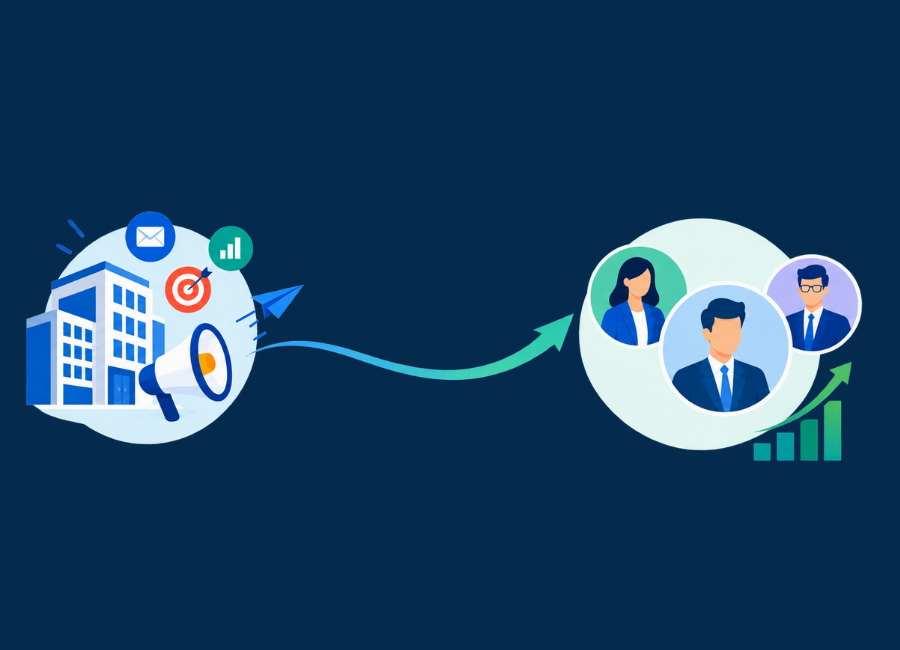
Most B2B companies do not have a traffic problem. They have a targeting problem. Sales receives contacts who were never going to buy, and marketing reports lead volume that never reaches pipeline. B2B marketing for lead generation fixes that upstream: decide which businesses to reach, find the people who influence purchases, and build a process that carries interest toward a sale.
What Is B2B Marketing for Lead Generation?
B2B marketing for lead generation is the practice of using marketing activity — content, search, email, social, advertising, and events — to attract businesses that match your ideal customer profile, capture contact details from decision-makers inside them, and qualify that interest into opportunities a sales team can pursue.
B2B marketing reaches organizations rather than consumers; lead generation turns that attention into contactable prospects. Quality matters alongside volume because B2B purchases involve several people and a budget approval. See our explainer on B2B marketing.
How Does B2B Lead Generation Work?
B2B lead generation runs as a repeatable sequence, and each step narrows the audience.
- Define the ideal customer profile.
- Identify target accounts and decision-makers.
- Select channels those roles use.
- Create offers matched to buying stage.
- Capture prospect information.
- Qualify leads on fit and interest.
- Nurture prospects who fit but are not ready.
- Hand qualified opportunities to sales.
- Measure against pipeline, then refine step one.
What Is the B2B Lead Generation Funnel?
Top of funnel is awareness, where the buyer researches a problem rather than a vendor. Middle of funnel is consideration, and an engaged contact there is usually a marketing qualified lead (MQL). Bottom of funnel is decision; once sales accepts the lead it becomes a sales qualified lead (SQL). That boundary works only if both teams set it together.
What Are the Main B2B Lead Generation Channels?
There is no universally best channel. The right mix depends on who you sell to and the length of the buying cycle.
| Channel | Primary Use | Example |
|---|---|---|
|
SEO |
Capture existing search demand |
Informational and commercial content |
|
Content marketing |
Educate prospects |
Guides, reports, case studies |
|
Email marketing |
Nurture and engage prospects |
Segmented campaigns |
|
LinkedIn |
Reach professional audiences |
Organic content and outreach |
|
Paid advertising |
Generate targeted traffic |
Search and social campaigns |
|
Webinars |
Educate and capture demand |
Product or industry sessions |
|
Referral marketing |
Leverage existing relationships |
Partner and customer referrals |
Relying on one channel is a structural risk: an algorithm change or a deliverability problem can remove much of your pipeline at once.

How to Build a B2B Lead Generation Strategy
Strategy connects those channels into a process. Four decisions do most of the work.
Define Your Ideal Customer Profile
Your ICP describes the organization, not the person: company size, industry, geography, revenue band, technology in place, the need you address, and buying triggers such as funding or a leadership change. Write it from evidence, separating attributes that predicted fit from attributes merely true of good customers. See our breakdown of firmographic versus demographic data.
Identify the Right Decision-Makers
A fitting account is not a lead until you know who to address. Department tells you whose problem you solve, seniority whether the person approves spend or only recommends it, and purchasing influence separates the signer from the evaluator. Plan for a buying group.
Match Content to Buyer Intent
Match the offer to where the buyer is. Awareness-stage readers want the problem framed. Consideration-stage readers want comparisons and webinars. Conversion-stage readers want pricing context, sample data, and a route to a conversation.
Create Conversion-Focused Landing Pages
The landing page is where interest becomes a lead, and small friction costs real volume.
- A clear value proposition in the first screen.
- One relevant call to action.
- Short forms — ask only what you need to qualify.
- Trust elements: customers, credentials, a privacy statement.
- Supporting content answering predictable objections.
- Mobile usability.
LinkedIn Lead Gen Forms and Google Ads lead form assets cut friction further by pre-filling in-platform.
How Can Content Marketing Generate B2B Leads?
Content marketing earns attention before a buyer is ready to talk to anyone, then gives it somewhere to go. Organic search makes it compound.
- Blog content: captures search demand.
- Industry guides: establish depth and anchor a topic.
- Whitepapers: suit committee-driven evaluations.
- Case studies: show it worked for a similar company.
- Webinars: capture registrations and attendance.
- Research reports: attract links and citations.
- Checklists: convert on immediate value.
How Does Email Marketing Support B2B Lead Generation?
Email both reaches prospects who have not engaged and nurtures those who have. Segment by industry, size, role, and behavior; match offers to funnel stage; and protect deliverability with verification, list hygiene, and reliable opt-out processing.
The FTC’s CAN-SPAM compliance guide requires accurate headers, truthful subject lines, a valid postal address, a working opt-out mechanism, and opt-outs honored within 10 business days; that duty cannot be contracted away to a vendor. For EU and UK contacts, the GDPR requires a documented lawful basis. This is general information, not legal advice — our guide to data compliance goes deeper.
How Can LinkedIn Support B2B Lead Generation?
LinkedIn exposes the two attributes that matter most for B2B targeting: where someone works and what they do there.
- Audience research — test whether your ICP exists at scale.
- Thought leadership from named people, not company pages.
- Relevant engagement in conversations buyers already have.
- Social selling — useful before any pitch.
- Direct outreach that is short and specific.
- Advertising against firmographic and role filters.
- Account-based marketing across a buying group.
Results accumulate over months, and volume without relevance degrades response rates everywhere else.
How to Qualify, Score, and Nurture B2B Leads
Qualification answers two questions: does the organization fit, and is the person interested enough to act. Fit is firmographic and role-based — industry, size, geography, seniority, purchasing influence — and is knowable at capture. Interest is behavioral and changes over time. HubSpot’s lead scoring documentation describes the same split as fit and engagement scores. Leads that fit but are not ready belong in nurturing.
How to Improve B2B Lead Quality
- Refine the ICP against closed-won and churned accounts.
- Segment so the right people self-select.
- Use intent signals such as repeat and pricing-page visits.
- Score fit and interest separately.
- Validate data at entry with format and duplicate checks.
- Verify contacts before campaigns, since B2B data decays.
- Filter firmographically to exclude unservable segments.
- Close the sales feedback loop — sales sees lead quality that marketing systems never record.
B2B Lead Generation Metrics to Track
Measure progression toward revenue, not activity. Any one metric read alone misleads.
| Metric | What It Measures |
|---|---|
|
Leads generated |
Total captured prospects |
|
MQLs |
Leads meeting marketing qualification criteria |
|
SQLs |
Leads accepted for sales follow-up |
|
Lead-to-opportunity rate |
Progression toward sales opportunities |
|
Cost per lead |
Acquisition efficiency |
|
Conversion rate |
Movement between funnel stages |
|
Pipeline contribution |
Leads associated with sales pipeline |
Published benchmarks vary so widely by sector and definition that they rarely work as targets. Compare against your own trend line; our guide on tracking B2B marketing performance covers cadence.
Common B2B Lead Generation Mistakes
- Targeting everyone — a broad ICP produces volume sales cannot use.
- Buying unverified data — see our checklist on choosing a B2B email list.
- Optimizing for lead volume alone.
- Ignoring buyer intent, wasting paid traffic on the wrong offer.
- Generic email campaigns that train recipients to ignore you.
- Neglecting landing-page experience, especially on mobile.
- Failing to nurture leads who were simply early.
- Misaligned sales and marketing.
- Inconsistent follow-up.
- Measuring vanity metrics.
B2B Lead Generation Examples in Practice
These are illustrative scenarios, not customer case studies, and no results are implied.
A SaaS company targeting operations leaders. The ICP is mid-market logistics firms running a named warehouse management system. The team publishes search-led content on specific bottlenecks, runs LinkedIn ads filtered to operations titles, and uses an ROI calculator to capture leads.
A healthcare supplier targeting procurement professionals. The ICP is hospitals and surgical centers within set bed-size and geographic bands. Because procurement directors rarely complete web forms, the program leans on verified contact data for outbound email. Our healthcare lead generation guide covers sector mechanics.
A B2B service provider targeting CFOs. The ICP is private companies approaching an audit or funding event, and the offer is a diagnostic assessment rather than a demo. Qualification weights the trigger heavily, because timing separates a good-fit CFO from a ready one.
How MedicoLeads Can Support B2B Lead Generation
All of this depends on knowing which organizations to target and reaching the right people inside them. MedicoLeads builds contact databases for healthcare and adjacent B2B markets, supporting several jobs in a lead-generation program:
- Audience segmentation by organization type and role.
- Prospect identification against your ICP criteria.
- Campaign targeting for email, outreach, and paid audiences.
- Industry-specific outreach to thinly covered specialties.
- Role-based targeting across procurement, clinical, and executive contacts.
- Geographic targeting scoped to sales coverage.
- CRM workflows running on one source.
A database is an input, not a strategy. See also our contact data best practices.
Related Resources
Frequently Asked Questions
What is B2B marketing for lead generation?
It is the use of marketing activity — content, search, email, social, advertising, and events — to attract businesses matching your ideal customer profile, capture contact details from decision-makers inside them, and qualify that interest into opportunities for sales.
How do B2B companies generate leads?
Most follow a sequence: define the ICP, identify target accounts and decision-makers, choose channels those roles use, publish offers matched to buying stage, capture contact details, qualify on fit and interest, nurture those not yet ready, and pass qualified opportunities to sales.
What are the most common B2B lead generation channels?
SEO, content marketing, email marketing, LinkedIn, paid search and social advertising, webinars, and referral marketing. No single channel is best for every business — the right mix depends on who you sell to and the length of the buying cycle.
How do you generate qualified B2B leads?
Qualify on two axes. Fit covers firmographic and role attributes such as industry, size, geography, and purchasing influence, and is knowable at capture. Interest covers behavior such as downloads and pricing-page visits. Score them separately and refine the weights using sales feedback.
What is the difference between B2B marketing and B2B lead generation?
B2B marketing is the whole discipline of reaching other organizations: positioning, brand, demand creation, and content. B2B lead generation is the narrower activity of converting that attention into identifiable, contactable prospects. A campaign can succeed as marketing and still produce no leads.
How does email marketing support B2B lead generation?
Email reaches prospects who have not engaged and nurtures those who have. Segmenting by industry, size, role, and behavior keeps messages relevant, while verification, list hygiene, and opt-out handling protect deliverability. US senders must follow CAN-SPAM rules; EU and UK data requires a lawful basis under GDPR.
How do you measure B2B lead generation?
Track leads generated, MQLs, SQLs, lead-to-opportunity rate, cost per lead, stage conversion rate, and pipeline contribution together. Any one read alone misleads — rising lead volume alongside a falling lead-to-opportunity rate usually signals a targeting problem.
How can businesses improve B2B lead quality?
Refine the ICP against closed-won and churned accounts, segment properly, use intent signals to prioritize, score fit and interest separately, validate data at entry, and verify contacts before campaigns. The fastest improvement usually comes from a working sales feedback loop.
Final Takeaway
Target the right audience, choose channels that reach them, create offers matched to their stage, capture and qualify leads, nurture those not yet ready, measure pipeline impact rather than activity, and optimize from there. If knowing which organizations and roles to reach is your next constraint, talk to us about a custom database.