

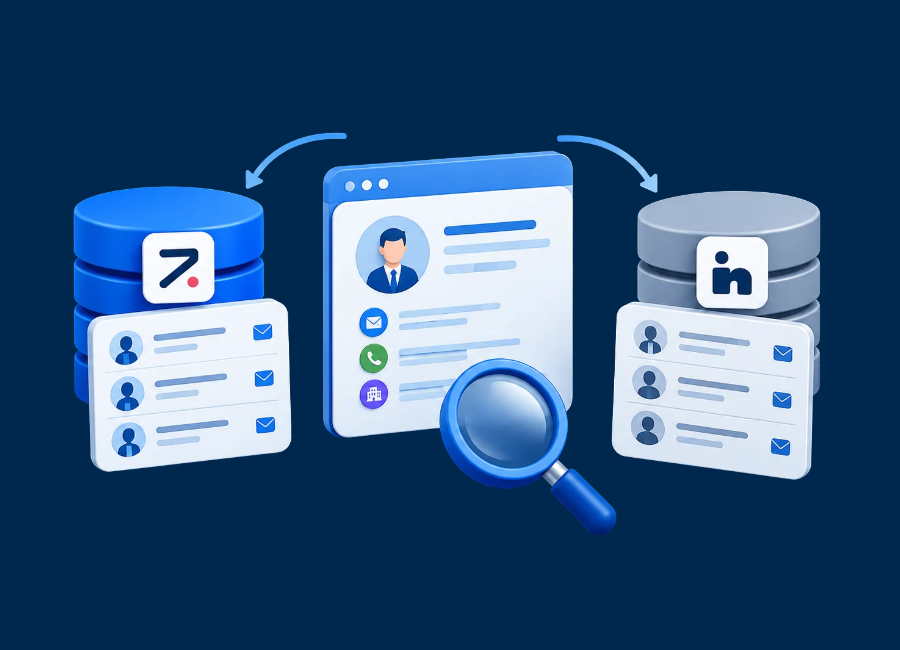
Most B2B data searches start by comparing database sizes, but headline record counts say little about how many usable contacts you can actually reach. ZoomInfo is one of the best-known names in the category, but it is one type of product among several.
The right choice depends on who you sell to, how specific your targeting needs to be, and how you prefer to access and purchase contact data.
How Does ZoomInfo Compare With Other B2B Contact Databases?
ZoomInfo is a broad B2B go-to-market intelligence platform that combines contact and company data with enrichment, buyer-intent signals, organizational insights, and sales workflow tools. It is well suited to teams selling across multiple industries, but it may not provide the depth required for highly specialized audiences such as healthcare providers, clinical decision-makers, or facility-specific buyers.
The right database is not necessarily the one with the largest advertised record count. It is the one that delivers the highest number of accurate, usable contacts matching your ideal customer profile.
What Should You Compare When Evaluating a B2B Contact Database?
When evaluating ZoomInfo or any B2B contact database, focus on practical usability rather than headline database size.
| Evaluation Factor | What to Check |
|---|---|
|
Contact coverage |
How many records match your ICP after filtering, not the headline total |
|
Data accuracy |
What the percentage measures and how it was tested, not just the figure |
|
Data freshness |
The revalidation cycle stated in days, and what happens to failed records |
|
Verification |
Whether records pass SMTP checks only, or human and phone verification too |
|
Contact attributes |
Which of your required fields are actually populated in a sample |
|
Segmentation |
Whether filters match how your audience is defined, including industry-specific ones |
|
Integrations |
Which CRM connections are native and bidirectional on your plan |
|
Compliance |
Published lawful basis, suppression handling and opt-out processing |
|
Pricing model |
Seats, credits, overage rates, export ceilings and renewal terms |
ZoomInfo vs. Other B2B Contact Databases: Key Differences
The table below sets out where the meaningful differences sit. It is not a ranking, and cells are left general where a capability varies by plan or is not publicly documented.
| Evaluation Factor | ZoomInfo | Other B2B Databases | What Buyers Should Check |
|---|---|---|---|
|
Contact coverage |
Reports 300M+ contacts across a broad horizontal database (company-reported) |
Varies widely; some report more, some publish no total at all |
Coverage inside your target market after filtering |
|
Data attributes |
Contact and company profiles, firmographics, org charts and buyer signals |
Varies by provider and plan tier |
Whether your required fields are populated |
|
Verification |
Documented in its trust centre alongside third-party privacy validations |
Ranges from automated checks only to multi-stage human and phone verification |
The verification method, not the headline accuracy figure |
|
Data freshness |
Continuous updating described across its product documentation |
Some publish a cadence in days; many publish none |
A stated revalidation cycle you can hold them to |
|
Industry coverage |
Broad, multi-industry B2B focus |
Some broad, some specialised in a single vertical |
Depth in your industry, not breadth overall |
|
Healthcare specialisation |
General B2B classification rather than clinical taxonomy |
Specialists model specialty, facility type and provider identifiers |
Whether clinical roles and facility types are filterable |
|
Intent data |
First-party intent and buyer signals included in higher tiers |
Some license Bombora, some offer none |
Whether intent is included or a paid add-on |
|
Integrations |
Native connections to Salesforce, HubSpot, Outreach, Salesloft and Gong |
Varies; some reserve two-way sync for top tiers |
Bidirectional sync on the plan you would buy |
|
Compliance |
Publishes SOC 2 and ISO certifications plus third-party GDPR and CCPA validations |
Varies; a few publish no compliance statement at all |
Documentation covering the regions you send into |
|
Pricing |
Quote-only, based on features, licences and credit usage |
Some publish full rate cards; others are quote-only |
Total cost modelled on your real export volume |
What Are the Main ZoomInfo Alternatives?
These providers appear most often alongside ZoomInfo in buyer evaluations. Positioning is summarised from each company’s own current public pages; verify anything that matters to you directly, since features and pricing change often.
Apollo.io
A self-serve platform bundling a contact database with sequencing and dialling. Apollo publishes a per-seat rate card and reports 240 million contacts and 30 million companies. Suits smaller teams wanting prospecting and outreach in one tool. Check which filters and intent topics your tier unlocks.
Cognism
Positioned around phone-verified mobile numbers and European coverage, with intent data licensed from Bombora. Cognism publishes no headline contact count, documenting its lawful basis and do-not-call screening instead. Pricing is quote-only. Check regional coverage for your territories.
Lusha
A contact-data and enrichment provider with a browser extension and API, sold self-serve on credits. Lusha reports 290 million contacts and publishes a per-region accuracy breakdown, which is unusual here. Check how credits are consumed for phone numbers versus emails.
UpLead
Positions on accuracy rather than scale, and is the most price-transparent provider here with a published rate card. It states on its own site that it does not offer the largest database. Check which filters and intent features sit behind the top tier.
Seamless.AI
Works as a real-time search engine rather than a static verified file, which is why its reported counts are far larger than others and not directly comparable. Paid pricing is quote-only. Check what verification you must run yourself.
For a longer list with fuller profiles, see our roundup of ZoomInfo competitors and alternatives.
Which B2B Contact Database Is Right for Healthcare Marketing?
Healthcare marketing often requires more than a job title and industry classification.
For example, a campaign targeting interventional cardiologists in hospital-owned practices or supply chain directors across specific health systems may require healthcare-specific attributes that general B2B databases do not model in sufficient detail.
General B2B databases commonly use business classifications such as SIC and NAICS codes. These classifications can be useful for identifying organizations, but they may not provide the clinical-level detail needed for healthcare campaigns.
Healthcare targeting may also depend on:
- Medical specialty
- Sub-specialty
- Provider role
- Facility type
- Hospital affiliation
- Geographic location
- License information
- NPI
- Healthcare organization type
This distinction matters for medical device, pharmaceutical, healthcare technology, staffing, and other B2B healthcare companies whose audiences are defined by clinical or healthcare-specific attributes.
Read our guide to B2B contact databases for healthcare marketers for more information.
What Makes a B2B Contact Database Useful for Lead Generation?
A B2B contact database becomes useful when its records can support your actual sales and marketing workflow.
Important factors include:
- Accurate business email addresses
- Direct phone numbers where required
- Current job titles
- Company information
- Industry classifications
- Geographic information
- Relevant segmentation fields
- CRM-ready data
- Data verification
- Regular data maintenance
Data freshness is especially important because professional contact information changes continuously as people change jobs, companies restructure, and organizations update their contact information.
A database with outdated records can lead to wasted outreach, lower campaign efficiency, and additional sales and marketing effort. See our guide on how outdated contact databases hurt B2B campaigns for more information.
Common Mistakes When Choosing a B2B Contact Database
Avoid these common errors when choosing a healthcare contact database:
- Choosing a provider based only on total database size
- Assuming a “verified” record remains accurate indefinitely
- Accepting a generic sample instead of one built around your real ICP
- Comparing advertised price without calculating credits, exports, overages, and renewal costs
- Reviewing feature lists before defining the fields your campaign requires
- Buying data before agreeing on target accounts, specialties, roles, facilities, and geography
- Assuming every B2B provider offers the same depth of healthcare coverage
- Failing to test CRM compatibility and export formats before signing a contract
- Ignoring how the provider handles opt-outs, suppression, privacy, and compliance
- A broad database may contain millions of healthcare contacts but still fail to identify the specific clinicians, facilities, health systems, or decision-makers relevant to your campaign.
How to Evaluate ZoomInfo or Any B2B Database Before Buying
Use the same checklist for every B2B contact-data provider:
- Define your ICP: Specify organization and facility type, specialty, role, seniority, geography, affiliation, and required data fields.
- Request a tailored sample: Ask for records matching your real campaign criteria—not a generic demo list.
- Check data quality: Review field completeness and independently test emails, phone numbers, titles, employer details, and healthcare attributes.
- Confirm verification and refresh: Ask how records are validated, how often they are updated, and how failed or outdated contacts are handled.
- Test usability: Confirm the data integrates with your CRM, marketing automation, and sales tools in the format you need.
- Calculate total cost: Include seats, credits, exports, API access, enrichment, overages, contract length, and renewal terms.
- Review compliance: Verify opt-out handling, suppression processes, privacy documentation, and applicable legal basis for outreach.
How MedicoLeads Supports Healthcare B2B Contact Targeting
MedicoLeads provides healthcare-focused B2B contact data for targeting professionals, executives, facilities, and healthcare organizations. Its published database includes 14M+ healthcare contacts across 170+ countries with 40+ data attributes.
Businesses can target contacts by:
- Specialty and sub-specialty
- Job title and seniority
- Facility type and affiliation
- Geography
- NPI and license information, where applicable
MedicoLeads states that its data undergoes a 7-tier verification process and is revalidated every 45 days. Data can be delivered in formats such as CSV, XLS, and API for sales and marketing workflows.
For healthcare campaigns requiring specialty- and role-level targeting, this approach provides more specific segmentation than broad industry-based databases.
Ready to Connect with the Right Healthcare Audience?
Frequently Asked Questions
What is ZoomInfo used for?
ZoomInfo is used by sales, marketing and revenue operations teams to find business contacts, research target accounts and enrich CRM records. It combines a horizontal contact and company database with firmographic data, buying-intent signals and integrations into tools such as Salesforce, HubSpot, Outreach and Salesloft. It is generally bought as an annual seat-based subscription with credits governing how many records you can export.
What are the main alternatives to ZoomInfo?
The alternatives that appear most often in evaluations are Apollo.io, Cognism, Lusha, UpLead, Seamless.AI, Lead411 and RocketReach among horizontal providers, plus industry specialists such as MedicoLeads for healthcare audiences. Which one fits depends on whether your binding constraint is price transparency, mobile phone coverage, European coverage, export volume or depth inside a single industry.
How do B2B contact databases differ?
They differ in how many contacts they hold in your specific segment, how records are verified, how often data is revalidated, which attributes are available as filters, which integrations are native, what compliance posture is published, and how they charge. Two providers reporting similar totals can return very different results once you filter to a narrow audience.
What should I check before buying a B2B contact database?
Check coverage inside your addressable market rather than the total record count, the verification method behind the accuracy claim, the revalidation cadence in days, whether the filters match how your audience is actually defined, integration support on the plan you would buy, published compliance practices, and the real cost once credits and overage are modelled against your usage.
How important is contact data accuracy?
Accuracy determines how much of what you buy is usable. Inaccurate records waste send volume, harm sender reputation and absorb sales time on wrong numbers. Published accuracy rates in this market typically run between 95% and 98%, but all of them are self-reported, so the only reliable measure is validating a sample built to your own specification before you commit.
How often should B2B contact data be updated?
There is no industry standard, and published cadences vary between providers. Because business contact data decays continuously through job changes, promotions and organisational restructuring, the important question is whether a provider will state its revalidation cycle in days and stand behind it. A provider that will not state a cadence is telling you something useful.
Is a general B2B database suitable for healthcare marketing?
It can be, for company-level targeting such as reaching health systems or healthtech vendors by size and location. It is usually less suitable when the audience is defined clinically, because general databases rarely model medical specialty, facility type, hospital affiliation or NPI as filters. Many healthcare teams pair a general platform with a specialist source.
How can I evaluate a healthcare B2B contact database?
Start from the clinical definition of your audience: specialty, role, facility type, geography and any identifier such as NPI. Confirm the provider can filter on all of them, ask for the verification method and refresh cadence, then request a sample built to that specification and validate it yourself. Check that the compliance practices documented cover the jurisdictions you send into.