

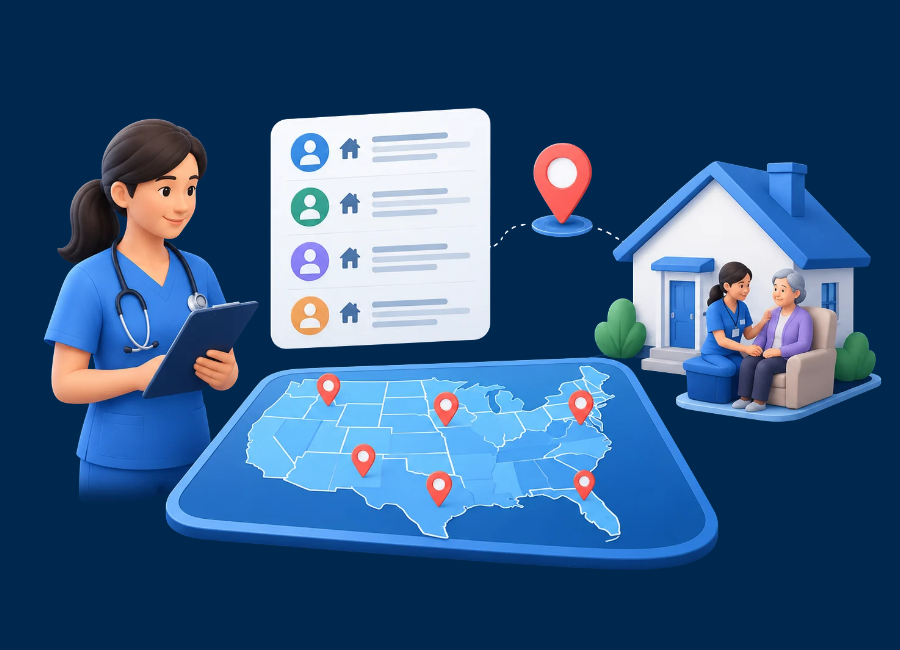
Home health is a highly local market. Agencies are licensed state by state, service areas are drawn around counties and ZIP codes, and the person who signs off on a purchase sits in one branch office. An undifferentiated national campaign wastes most of itself.
A home health agency contact list built by state and ZIP code fixes that: outreach matches the territories your reps cover. This guide covers the process, the fields worth collecting, and when buying a verified database beats building one by hand.
What Is a Home Health Agency Contact List?
A home health agency contact list is a B2B database of home health, home care and related post-acute organizations, with the business contact details of the people who run them. It is a sales and marketing asset, not a clinical one.
A usable list holds the agency name, address, city, state, ZIP code, website, phone, a named contact, their job title and a business email. Better lists add agency type, licence status, size and service area.
One distinction matters most: this is business contact data about organizations and the people who work in them. It is not patient data and contains no protected health information — it is what you would find on a company website, a state licence register or a public provider directory.
Why Build a Home Health Agency Contact List by State and ZIP Code?
Geography is the strongest practical filter here: home health is licensed by state and delivered by neighbourhood.
- Territory-based sales : A list segmented the way reps are drops straight into their patch.
- Regional marketing : Licensing rules, payer mix and referral patterns differ by state, so one message does not travel.
- Local campaign targeting : ZIP-level segments align email, mail and paid spend with a metro area or sales route.
- Expansion and prioritisation : A new state becomes a contained experiment, and geography plus agency type and size gives a defensible order of work.
One caution: location narrows a list, it does not qualify it. An agency in your best ZIP may still be the wrong size or already under contract. Geography is the first filter, never the only one.
How to Build a Home Health Agency Contact List
Nine steps. The first three decide whether the rest is worth doing.
1. Define Your Ideal Home Health Agency Profile
Write down what a good-fit agency looks like first: agency type (Medicare-certified home health, non-medical home care, hospice or combined), organization size, services delivered, and whether it is independent, chain or franchised. If your product needs agencies above a certain size, say so now — it removes thousands of records later.
2. Choose the States and ZIP Codes to Target
Start where you already win. Map closed deals to state and ZIP and look for concentration, then add constraints: where you are licensed or staffed, what a rep can cover, where your pricing works. Rank states into tiers and drill to ZIP level only inside tier one.
3. Find Home Health Agencies in Your Target Areas
Three sources do most of the work. CMS publishes a free, public-domain list of every Medicare-registered home health agency with addresses and phone numbers. State health departments publish licensed-agency directories, catching non-medical home care providers outside Medicare certification. Association and franchise locators fill the gaps. None gives a named decision-maker with a working email — that is the gap the rest of the process closes.
4. Identify Relevant Decision-Makers
Email the role, not the building. Usually the Agency Administrator or Executive Director, the Director of Nursing or Clinical Director, the owner at independent agencies, the Business Development Director for referral offers, or the Billing Manager for financial software.
5. Collect Business Contact Information
Build every record on the same field set: agency name, contact name, job title, email, phone, website, street address, city, state, ZIP. Keep generic inbox addresses but tag them role-based so campaigns treat them differently.
6. Segment the Contact List
Segment as you collect. Tag every record with state, ZIP and agency type at minimum, plus job title, size and territory if campaigns need them. At entry this costs minutes; retroactively it costs days.
7. Verify and Clean the Data
Home health is high-churn: agencies open, close, merge and change hands, and administrators move. Verify emails before sending, confirm the contact still holds the role, de-duplicate branches of one parent, and standardise addresses so ZIP segments work. Our guide to healthcare contact data hygiene covers maintenance.
8. Review Compliance and Data-Use Requirements
B2B outreach to agency staff is governed by commercial email rules, not patient-privacy rules. The FTC’s CAN-SPAM Act compliance guide requires accurate headers, honest subject lines, a valid physical address and opt-out handling within ten business days; state privacy laws may add more. Keep a suppression list — see our overview of data compliance in B2B marketing. General information, not legal advice.
9. Prepare the List for Sales and Marketing Campaigns
Export with consistent headers, map fields to your CRM before import, and assign records by territory. Then set the sequence: which state tier goes first, which segment gets email, which gets a call. Our guide to a targeted medical email list campaign covers execution.
What Data Fields Should a Home Health Agency Contact List Include?
At minimum: agency name, contact name, job title, business email, business phone, street address, city, state and ZIP code. Those nine fields make a list usable for both email and territory-based calling.
Worth adding where available:
- Website : For research and ICP checks
- Agency type : Certified home health, non-medical home care, hospice or combined
- Geographic coverage : The counties or ZIPs served, often wider than where the office sits
- Organization size and SIC or NAICS code : For sizing and cross-system matching
- Ownership : Independent, chain, franchise or parent organization
- Last-verified date : The most underrated field in any contact file
No database holds every field for every record. Decide which your campaign depends on and judge completeness on those.

How to Segment Home Health Agency Contacts by State and ZIP Code
Useful segmentation stacks two or three attributes rather than relying on one:
- State — the base layer, matching licensure and rep coverage
- ZIP code — for routing, local events and dense metro targeting
- City or metro area — usually more meaningful than a single ZIP for messaging
- Territory — a named group of states or ZIPs mapped to one owner
- Agency type, size and job title — a small non-medical agency and a large certified one are different buyers, and the clinical director and billing manager need different messages.
One caveat: ZIP codes are not geographic areas. The US Census Bureau notes a ZIP Code is a USPS trademark for coordinating mail handling, assigned to delivery routes rather than mapped areas. For radius or drive-time targeting, pair ZIP with city, county or ZIP Code Tabulation Area.
Build the List Yourself or Use a Healthcare Contact Database?
Both work. It depends on how many markets you cover and how often the data needs refreshing. Building in-house suits a narrow, stable footprint; a healthcare contact database suits multi-state coverage and short timelines.
| Building the List In-House | Using a Healthcare Contact Database |
|---|---|
|
Research time measured in weeks per state |
Coverage available in days across many states |
|
Field consistency depends on who collected the record |
A single schema applied across every record |
|
You verify every email and phone number yourself |
Verification handled before delivery |
|
Geographic segmentation done manually in a spreadsheet |
State, ZIP and territory selects applied at build time |
|
Fully customisable, limited only by your time |
Customisable to an ICP specification you supply |
|
Scales poorly beyond two or three states |
Scales to national coverage without extra headcount |
|
Ongoing maintenance is a permanent internal cost |
Refresh handled by the provider on a set cycle |
A reasonable middle path: build manually in the one or two states where you want deep knowledge, and buy coverage for the rest. If you buy, our checklist on choosing a healthcare contact data provider and our guide to the skilled nursing facilities email list cover adjacent post-acute segments.
How MedicoLeads Helps Build a Targeted Home Health Agency Contact List
If building state by state exceeds your timeline, MedicoLeads’ homecare agency mailing list supplies that contact layer ready-segmented.
- State and ZIP-code targeting – Records carry address, city, state and postal code, so segments cut to your territory map
- Custom geographic segmentation – Audiences built to a defined set of states, metros or ZIP ranges
- Decision-maker targeting – Job-title selection across administrative, clinical and management roles
- Contact verification – Records validated before delivery
- Multiple data attributes – Contact name, job title, email, phone, website, address, industry classification and employee size
- Company-level filtering – By agency type, service focus, licence status and size
- Customized databases – Built to your ICP specification rather than a pre-packaged file
- Campaign-ready formats – CSV or XLS that load into standard CRM and marketing platforms
On scope: this is B2B contact data for agencies and the people who run them. It holds no patient information and is for sales and marketing use.
FAQs About Home Health Agency Contact Lists
1. What is a home health agency contact list?
It is a B2B database of home health, home care and hospice organizations plus the business contact details of the people who run them — agency name, address, city, state, ZIP code, phone, website, a named contact and job title. It holds business information only, never patient data.
2. How can I find home health agencies by state?
Start with the CMS list of Medicare-registered home health agencies, which is free and public and includes addresses and phone numbers. Add your state health department’s licensed-agency directory to capture non-medical home care providers. Neither source supplies named decision-makers or business emails, so expect to enrich afterwards.
3. Can home health agency contacts be segmented by ZIP code?
Yes. Any list with a full business address can be segmented to ZIP level for territory routing and local campaigns. Bear in mind ZIP codes are mail delivery routes, not mapped areas, so for radius targeting pair ZIP with city, county or ZIP Code Tabulation Area.
4. What information should a home health agency contact list include?
At minimum: agency name, contact name, job title, business email, business phone, street address, city, state and ZIP code. Useful additions are website, agency type, geographic coverage, organization size, SIC or NAICS code, ownership or franchise affiliation, and a last-verified date on every record.
5. Who should I target at a home health agency?
It depends what you sell. Agency Administrators and Executive Directors own budget decisions. Directors of Nursing evaluate clinical tools and staffing. Business Development Directors handle referral offers. Billing Managers assess financial software. At small independent agencies the owner often fills several roles at once.
6. How do I verify home health agency contact information?
Verify the email before sending, confirm the contact still holds the role, cross-check the agency against a current licence or Medicare registration, de-duplicate branches of one parent, and standardise addresses. Home health churns fast, so re-verify on a cycle rather than once.
7. Can I buy a customized home health agency contact list?
Yes. Most healthcare data providers will build to a specification rather than selling only pre-packaged files. Supply your target states and ZIP codes, agency types, organization sizes and job titles, then ask for a sample from that exact segment so you can check field completeness before committing to a full order.
8. How can a home health agency contact list support B2B marketing?
It underpins territory-based prospecting, regional email campaigns, account-based outreach to larger agency groups, direct mail, event invitations by metro area, and market-expansion testing. Segmented by state, ZIP and job title, the same file supports both a targeted email programme and a rep’s daily call list.