Blog / Healthcare Lead Generation / Physician data

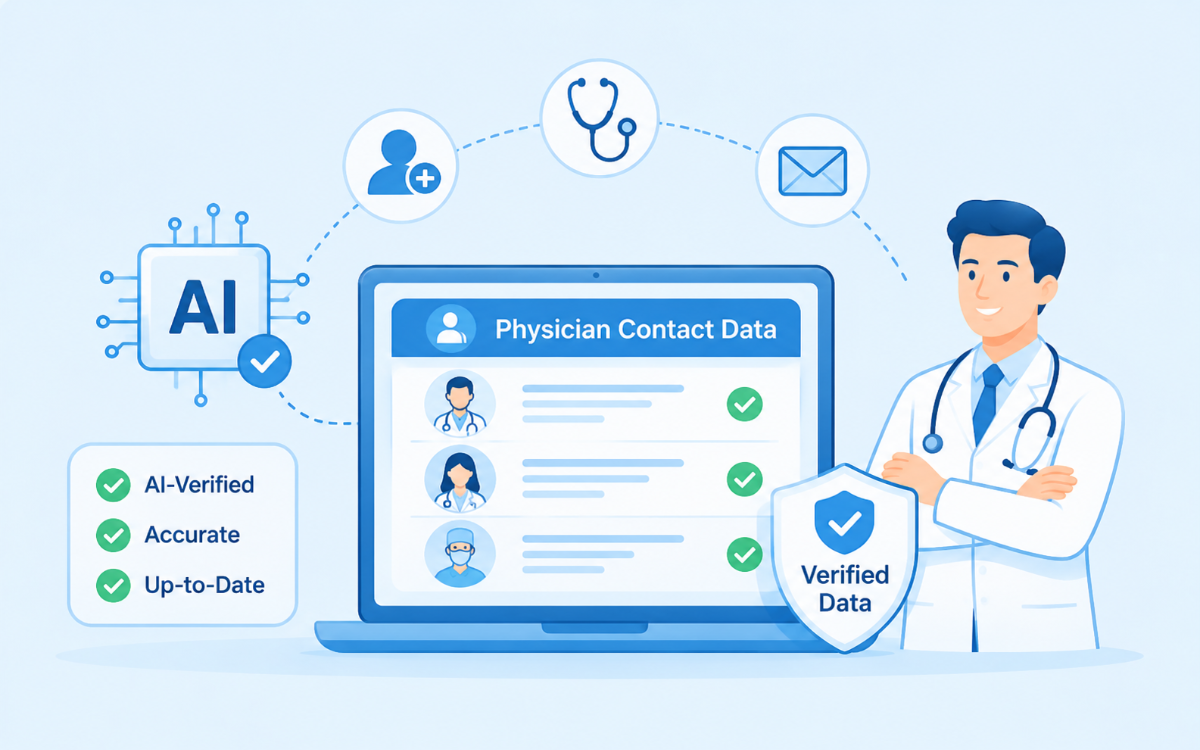
AI-Verified Physician Contact Data: What It Actually Means

AI verification is now on almost every data provider’s homepage. Here is what the term can legitimately mean, what it cannot do, and how to test the claim.

HK

Harshith Kumar

Healthcare data writer
Updated 5 Nov 2026
9 min read
AI-Verified Physician Contact Data What It Actually Means

TABLE OF CONTENTS

Reading progress

QUICK ANSWER

AI-verified physician contact data means machine learning is used to score, match and prioritise records rather than to confirm facts outright. Models are good at resolving identities across inconsistent sources, predicting which records are likely to have decayed, and flagging conflicts for review. They cannot independently establish that a physician still works somewhere. Treat AI verification as a triage layer that decides what gets checked, not as a replacement for checking.

Almost every healthcare data provider now describes its records as AI-verified. The phrase has spread faster than any shared definition of it, which makes it close to useless as a buying signal unless you ask what the model actually does.

There is a real capability underneath the marketing. Machine learning genuinely solves problems that rule-based matching handles badly: deciding whether two differently formatted records describe the same physician, estimating which records have most likely gone stale, and spotting patterns that indicate a practice has been acquired. Those are meaningful improvements over a static quarterly refresh.

What a model cannot do is observe the world. No system infers from existing data that a cardiologist changed hospitals last month unless some source recorded it. This guide separates the two, so you can read a provider’s AI claim and tell which half you are being sold.

What AI Verification Means in Practice

Strip away the branding and AI verification usually refers to one of three things, which differ enormously in value.
  • Probabilistic matching — deciding whether records from different sources describe the same physician, despite name variants, formatting differences and multiple practice addresses.
  • Decay scoring — predicting which records are most likely to be out of date, so limited re-verification capacity goes where it matters.
  • Anomaly detection — flagging records whose attributes have become internally inconsistent, which often indicates an unrecorded practice change.
All three are prioritisation tasks. They decide what to examine and in what order. None of them confirms a fact, and a provider describing any of them as verification is using the word loosely. The confirmation still has to come from a source that observed the change.

The Problem AI Is Genuinely Good At

The real constraint in healthcare data is not knowing how to verify a record. It is that there are far more records than any team can verify at the frequency the data decays.
The decay rate is substantial. Research in Annals of Internal Medicine from a Weill Cornell Medicine team found annual physician turnover rose from 5.3% to 7.6% between 2010 and 2018, a 43% relative increase, and turnover is only one of several drivers alongside acquisitions, domain changes and role moves. Verifying a large physician database exhaustively every quarter is not economically realistic.
That makes the allocation problem the one worth solving. If a model can identify the 15% of records most likely to have changed, the same verification budget covers the records that actually needed it. This is where machine learning earns its place, and it is a meaningful improvement over refreshing everything on a fixed calendar.

Identity Resolution Across Inconsistent Sources

Physician records arrive from sources that disagree about almost everything except the person. One lists Dr. Katherine M. Reyes at a hospital, another K. Reyes MD at an affiliated clinic, a third Katherine Reyes with a different middle initial. Deterministic matching on name and address either merges records it should not or keeps duplicates it should have linked.
Probabilistic models handle this considerably better because they weigh many weak signals together: name similarity, specialty agreement, geographic proximity, shared affiliations and identifier overlap. The output is a match confidence rather than a binary decision, which lets high-confidence matches resolve automatically while borderline cases route to review.
This matters commercially as well as technically. Unresolved duplicates inflate the count you pay for and cause the same physician to receive a campaign several times, which raises spam complaints. Our breakdown of how inaccurate physician data burns marketing budget covers why complaints are more damaging than bounces.

Predicting Which Records Have Probably Decayed

Decay is not uniform. An established physician who has held the same role at the same practice for a decade is far less likely to have moved than an early-career physician at a recently acquired group. A model trained on historical change patterns can estimate that difference.
Useful features include time since last confirmation, career stage, practice type and size, whether the practice has been involved in recent consolidation, and how volatile the specialty has been historically. The output is a per-record probability that something has changed.
The important thing to understand is what that score is not. A low decay score does not mean the record was checked and found correct. It means the record was not prioritised for checking. Those are very different statements about reliability, and providers rarely distinguish them clearly.

Detecting Practice Changes From Indirect Signals

The third legitimate application is spotting that something changed before any source explicitly reports it. If a practice domain stops resolving, several physicians at one address begin appearing elsewhere, or a group’s web presence is replaced by a health system brand, those patterns together indicate an acquisition.
Pattern detection of this kind is valuable precisely because registry data lags. In its notice on National Plan and Provider Enumeration System data changes, HHS stated that provider practice addresses change frequently and are therefore unlikely to be maintained accurately, and encouraged providers to review their own records. A system waiting for the registry to update will be late by whatever interval the physician takes to file.
Again the output is a flag, not a fact. The system has established that these records deserve attention, not what the new truth is.

24 TO 48 HOUR DELIVERY

Want to Test a Data Provider's Accuracy Claim?

Send your target specialties, roles and regions. We will confirm available counts and share sample records with verification dates so you can check them yourself.

What AI Verification Cannot Do

The central limitation is simple and does not go away with a better model. A system reasoning over existing data cannot observe events that no source recorded. If a physician moved practices last month and nothing has yet published that fact, no amount of inference recovers it.
Three further limits are worth stating plainly:
  • It cannot populate missing fields. A model can predict a plausible value, but a predicted specialty presented as a known one is a fabrication with a confidence score attached.
  • It inherits source bias. If underlying sources cover large health systems better than independent practices, the model is systematically less reliable for independents, and the confidence scores will not reveal this.
  • It cannot establish permission. Consent and opt-out status are legal facts about a relationship, not attributes that can be inferred from other data.
On that last point: this is general information rather than legal advice. US commercial email is governed by the CAN-SPAM Act, which requires a functioning opt-out mechanism and prompt honouring of requests. Campaigns reaching the UK or EU face separate obligations. Confirm your position with qualified counsel.

Confidence Scores and How to Read Them

Providers increasingly ship a confidence or accuracy score with each record. Used well this is a genuine improvement on an undifferentiated file, because it lets you treat records differently according to how certain they are.
To use the score you need to know what it measures. Ask three questions: what the score predicts, what it was calibrated against, and when it was last recomputed. A score predicting deliverability is a different product from one predicting that the role is current, and a score calibrated on bounce outcomes says nothing about role accuracy however high it is.
A well-calibrated score should also be testable. If records scored above 90% bounce at roughly the same rate as records scored at 60%, the score is decorative. Running that comparison on your first campaign is a quick and fair test of whether the number means anything.

AI Claims and What They Usually Mean

The table below maps common marketing phrasing to the underlying capability and the question that cuts through it.
The claim What it usually means The question to ask
AI-verified records
Models score and prioritise; some records were then checked
What share of my segment was actually confirmed, and how?
Real-time verification
Checks run when a record is requested or exported
Which checks run live, and which use cached results?
Machine learning accuracy
Predicted likelihood of correctness, not measured accuracy
What was the score calibrated against, and when?
Continuously updated
Some pipeline runs continuously, not every record
What is the median age of records in my segment?
AI-powered matching
Probabilistic identity resolution across sources
What identifier anchors a match, and what happens to ties?
Predictive data quality
Decay scoring to prioritise re-verification
Does a good score mean checked, or mean not prioritised?
99% accuracy guaranteed
Usually a deliverability figure, not record accuracy
Accurate on which fields, and what is the remedy if not?
The pattern across the right-hand column is the same: move the question from the database as a whole to your specific segment, and from capability to evidence.

Want Counts Confirmed Against Your Exact Filters?

Share your targeting criteria and we will confirm what is available in your segment before you commit.

How to Test an AI Verification Claim

You do not need to understand the model to evaluate the output. Four tests, run on a sample of a few hundred records, tell you most of what matters.
  • Check score calibration. Split the sample by confidence band and compare actual bounce rates. If the bands do not separate, the score carries no information.
  • Spot-check role accuracy manually. Take 20 records and compare role and employer against public practice pages. Models rarely catch role drift, so this is where errors concentrate.
  • Ask for verification dates per record. A file-level claim of continuous updating is not evidence. A date attached to each row is.
  • Test an edge segment. Request a small, awkward segment such as independent practices in a rural state. Coverage gaps and source bias appear there first.
The fourth test is the most revealing and the least often run. Providers optimise for their high-demand segments, so performance on a common specialty in a major metro tells you little about the file you will actually be buying. Our guide to how layered verification works sets out what should be happening behind each of these checks.

Where MedicoLeads Uses Automation and Where It Does Not

MedicoLeads uses automated matching and prioritisation for the tasks described above: resolving records that describe the same physician across sources, scoring which records most likely need re-checking, and flagging conflicts where sources disagree. These steps decide what gets examined.
Confirmation is handled separately through layered checks, with records where automated signals conflict routed to human review rather than resolved by picking the higher-scoring source. Records that cannot be resolved are removed rather than shipped with a confidence number attached, and each record carries the date it was last confirmed.
The distinction is the point of this article rather than a product claim: automation that decides what to verify is useful and worth paying for; automation presented as having done the verifying is a different proposition. Ask any provider, including this one, which of the two they are describing.

Conclusion

AI verification is a real capability wrapped in an unhelpfully vague phrase. Models resolve identities across messy sources, predict which records have decayed, and surface changes before registries record them. Each of those meaningfully improves a physician database.
What they do not do is observe the world. The useful question is therefore never whether a provider uses AI, but which part of the work it does. Automation that decides what to check is valuable. Automation presented as the check itself is a prediction wearing the word verified, and it will deliver perfectly into the wrong inbox.

Frequently Asked Questions About AI-Verified Physician Data

It usually means machine learning is used to match records across sources, score which records are likely to have decayed, and flag conflicts for review. All three are prioritisation tasks that decide what gets examined. None of them confirms a fact on its own, so the confirmation still has to come from a source that observed the change.

They solve different problems. AI handles scale, deciding which records among millions most need attention, which no manual process can do. Human review resolves cases where sources conflict, which models handle poorly. A serious process uses both: automation to triage, people to adjudicate the hard cases.

Only indirectly. A model can detect patterns suggesting a change, such as a practice domain going dead or several physicians at one address appearing elsewhere. That produces a flag indicating the records deserve attention. It does not establish where the physician went, which requires a source that recorded the move.

It depends entirely on what the score predicts and what it was calibrated against. A score predicting deliverability says nothing about whether the role is current. Ask what the score measures, what data it was calibrated on, and when it was recomputed. Then test it by comparing bounce rates across confidence bands.

Because role changes often leave no trace a model can observe. When a practice is acquired, an owner may become an employed clinician while the person, address, specialty and email all stay the same. Nothing in the available data signals that purchasing authority has moved, so the record continues to look correct.

Not necessarily, and this is the most common misreading. In decay-scoring systems a low risk score means the record was not prioritised for re-verification, which is a different statement from having been checked and confirmed. Ask the provider directly which of the two a good score represents.

Request a sample and run four checks: compare bounce rates across confidence bands to see whether the score separates, manually verify 20 records against public practice pages, confirm that each record carries its own verification date, and request an awkward edge segment where coverage gaps and source bias appear first.

Only if the provider can say what the automation does and show evidence it works on your segment. Automation that prioritises re-verification intelligently is worth paying for. A model output relabelled as verification is not, and the difference is visible in whether the provider can answer what happens to records the system cannot resolve.

Ready to judge data quality on evidence rather than claims?

Tell us the specialties, roles and regions you need. We will confirm counts and share sample records with verification dates so you can run your own checks.

ABOUT THE AUTHOR

Picture of Aiden Mason

Aiden Mason

Aiden Mason is a content marketing professional who has been with MedicoLeads since it was founded in 2016. He writes about new trends in B2B healthcare marketing, data and outreach.

FREE SAMPLE

See verified physician records before you buy

Get sample physician records in your target specialties and regions, with verification dates attached.
No commitment. Reply within one business day.

TALK TO US

Ready to Reach the Right Physicians?

Tell us who you want to reach. Our data experts will confirm available counts and share a sample within one business day.
Scroll to Top