

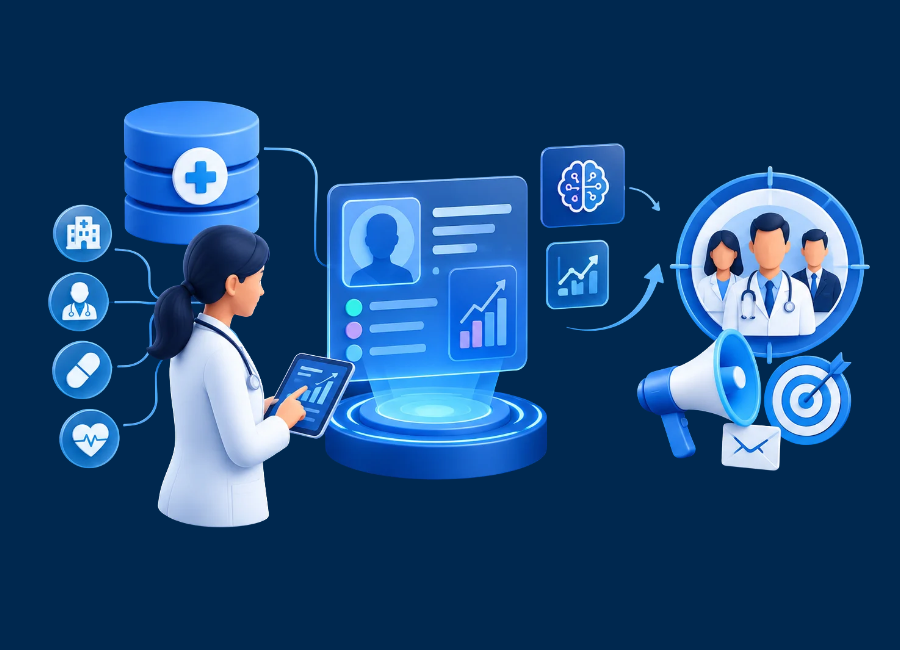
Healthcare marketing teams rarely lack contacts. One database can hold hundreds of thousands of physicians, nurses, administrators and executives. The harder question is which records deserve a sales call this quarter, which belong in a nurture track, and which should be left alone.
Predictive healthcare data is one way to answer that. It uses patterns in data a company already holds — campaign outcomes, firmographic attributes, professional roles — to rank prospects by likely fit. It will not tell you who will buy. It shows where the evidence sits, so limited capacity goes to the segments most likely to respond.
This guide covers how it works, which signals matter, where it fails, and how it differs from the healthcare contact databases most teams already license.
What Is Predictive Healthcare Data?
Predictive healthcare data is business contact and firmographic data about healthcare professionals and organizations that has been analyzed to estimate a future outcome — usually which accounts are most likely to fit an offer, respond to outreach, or progress through a sales cycle.
It describes organizations and professional roles, not patients. It is not built from protected health information, and treating B2B contact data and patient records as one category is a serious compliance error. Five inputs normally feed it:
- Healthcare contact data – Verified business email, phone, title, organization
- Firmographic and professional attributes – Facility type, size, ownership, specialty, department, seniority, NPI (see firmographic vs demographic data)
- Historical outcomes – Which segments previously opened, replied or bought
- Engagement signals – Campaign and site behaviour your systems legitimately capture
- A model – Logic that turns the above into a score or rank
Four terms recur below. Predictive analytics uses historical data to estimate future outcomes. Lead scoring rates a lead on fit and engagement. Healthcare data enrichment adds missing attributes to records you hold. Account-based marketing (ABM) treats a defined set of organizations as individual markets.
How Does Predictive Healthcare Data Work?
Most predictive workflows run through the same eight stages, whether the logic sits in a CRM, an automation platform or a spreadsheet.
- Data collection : Contact records, firmographics and your own CRM history.
- Data validation : Remove duplicates, correct role changes, drop dead records.
- Data enrichment : Fill gaps such as specialty, facility type or organization size.
- Signal identification : Decide which attributes plausibly relate to the outcome.
- Pattern analysis : Compare won and lost deals against those attributes.
- Prioritization : Turn the pattern into a score, a tier, or a ranked list.
- Activation : Route top records to sales, mid-tier to nurture, the rest to broad campaigns.
- Feedback : Reed outcomes back and adjust. Without this, the model is a one-time guess.
Treat any proprietary methodology you cannot inspect as a black box, and judge it on measurable results rather than the description.
Predictive Healthcare Data vs. Traditional Healthcare Databases
A traditional database answers who can we contact? Predictive healthcare data answers who should we contact first? The second question is only answerable once the first is answered well, which is why predictive work sits on top of a contact database rather than replacing it. A team with an accurate, well-segmented healthcare email list and no model will usually outperform a team with a sophisticated model running on stale records.
| Traditional Healthcare Database | Predictive Healthcare Data |
|---|---|
|
Static contact records: name, title, organization, email, phone |
The same records, plus a score or rank suggesting where to start |
|
Segmentation by fixed attributes such as specialty or geography |
Segmentation informed by patterns in past campaign and sales outcomes |
|
Refreshed on a set cycle |
Re-scored as new outcomes and engagement signals arrive |
|
Answers: who can we contact? |
Answers: who should we contact first? |
|
Useful on its own for list building and outreach |
Cannot function without an underlying contact database |
|
Judged on accuracy, coverage and field completeness |
Judged on model inputs, transparency and how the output is used |
Both depend on the same foundation: complete, current, correctly attributed business records.
How Predictive Healthcare Data Supports B2B Marketing
Predictive insight earns its place where a team has more addressable contacts than capacity to work them.
- Lead prioritization : Rank inbound and list-sourced leads so reps work the strongest fits first.
- Audience segmentation : Build segments around attribute combinations that historically responded, not specialty alone.
- Account-based marketing : Shortlist target organizations and size the buying group inside each, as our guide to account-based marketing in healthcare sets out.
- Prospecting and email marketing : A defensible call order, and offers that vary by tier instead of one campaign for the whole file.
- Campaign personalization : A 40-bed rural hospital CFO and an IDN supply chain director need different proof.
- Demand generation and sales alignment : Concentrate budget on the best-converting segments, and replace arguments about lead quality with a shared definition of a priority account.
- Territory planning, cross-selling and expansion : Distribute accounts by modelled potential, find customers who match buyers of a second product line, and test whether a winning profile repeats in a new market.
None of this removes judgement. A score is an input to a decision a rep still makes.
Predictive Healthcare Data Use Cases by Industry
Medical Device Companies
Device cycles involve clinicians, biomedical engineering, supply chain and value analysis committees. Ranking by facility type, service lines and past win patterns helps a team decide which hospitals to approach first, as our guide on how to market medical devices to hospitals explains.
Pharmaceutical Companies
B2B targets here are group purchasing organizations, pharmacy directors, formulary committees and distributors. Scoring by organization type, group size and prior engagement helps field teams decide where limited in-person time goes — commercial targeting of businesses, not promotion aimed at patients.
Healthcare Technology Companies
Health-tech vendors sell to CIOs, CMIOs, revenue cycle leaders and practice administrators. Predictive segmentation separates organizations plausibly in a buying window from those years away from replacing a core system.
Healthcare Service Providers
Billing companies, staffing firms and lab networks sell to many small organizations rather than a few large ones. The value is efficiency: find the practice sizes, specialties and regions where conversion has been strongest, then concentrate outreach there.
Healthcare Recruiters
Recruiters build audiences on role, credential, specialty and geography. Placement history shows which facility types and markets respond, which helps sequence outreach during hiring peaks.

Benefits of Predictive Healthcare Data
- Clearer prioritization : A defensible order of work rather than an arbitrary one
- Sharper segmentation and more relevant campaigns : Built on observed response, not assumption
- More efficient outreach : Fewer calls into accounts that were never a fit, which also protects sender reputation
- Evidence for decisions : Budget and territory discussions grounded in patterns rather than opinion
These are directional benefits, not guarantees. Outcomes still depend on data quality, offer strength, market conditions and execution.
Limitations and Challenges of Predictive Healthcare Data
Predictive healthcare data fails in predictable ways, and knowing them separates a useful programme from an expensive one.
- Data quality ceilings – A model inherits every error in its inputs, so healthcare contact data hygiene matters more than model sophistication.
- Incomplete and outdated records – A missing facility type or a departed contact produces confident but wrong scores.
- Model bias – Trained on past wins, a model keeps recommending segments you already sell to, quietly blocking expansion.
- False positives and false negatives – High-scoring accounts that never engage burn sales time, while good accounts unlike prior buyers get buried.
- Missing context – Budget freezes, GPO contracts, incumbents and internal politics appear in no dataset.
- Small samples – Niche segments often lack enough closed deals to show a real pattern.
- Need for human validation : Reps who know a territory should be able to override a score and say why.
On compliance: B2B healthcare contact data is not protected health information, but marketing teams still operate under rules. The U.S. Department of Health and Human Services sets out when HIPAA restricts marketing uses of protected health information, including that covered entities cannot sell patient lists for marketing without authorization. Commercial email is separately governed by the FTC’s CAN-SPAM Act compliance guide: accurate headers, honest subject lines, a valid physical address, and opt-out handling within ten business days. EU and UK campaigns carry further obligations. This is general information, not legal advice.
How to Choose a Healthcare Data Provider
Predictive work is only as good as the records underneath it, so provider selection is the highest-leverage decision in the process. Use a consistent checklist:
- Accuracy and verification : How accuracy is measured, what is checked, and by what method
- Update frequency : How fast role changes and departures appear
- Segmentation options : Specialty, role, department, facility type, organization size
- Industry and job-title coverage : Providers, facilities, payers, suppliers; clinical through executive
- Geographic coverage : The countries, states or metros you sell into
- Customization : Whether a build-to-spec audience is possible
- Compliance documentation : Sourcing, consent posture and suppression handling, in writing
- Data fields : The exact attributes delivered, including the ones your model needs
- Sample availability and support : A real sample from your segment, and someone to call when a file misses the brief
Our walkthrough on choosing a healthcare contact data provider turns each into questions for the call.
How MedicoLeads Supports Data-Driven Healthcare Marketing
Predictive models need a dependable contact layer to run on. MedicoLeads supplies that layer: B2B contact data for healthcare professionals, executives and organizations, prepared for prospecting, segmentation and campaign work.
- Healthcare professional and executive contact data across clinical, administrative and leadership roles
- Industry and specialty-based segmentation, so audiences follow how your market is organized
- Job-title targeting for the decision-makers and influencers in a buying group
- Company and organization targeting by facility type and profile, which supports ABM list building
- Geographic targeting for territory planning and regional campaigns
- Contact-level attributes — role, specialty, organization, location — that feed enrichment and scoring
- Custom healthcare database requirements built to a defined audience specification
- Data verification and validation applied before delivery
- Campaign-ready audiences in formats that load into CRM and marketing platforms
- Sample data availability, so you can review fields and relevance before committing
On scope: MedicoLeads provides healthcare B2B contact data and segmentation. The predictive layer — scoring, modelling, prioritization logic — is what your team builds in its own CRM or analytics stack, using this data as the input.
The Future of Predictive Healthcare Data in B2B Marketing
The direction of travel is toward tighter targeting and better-documented data practices, not fully automated decisions.
- More granular segmentation : Department and role-level audiences rather than broad specialty lists
- AI-assisted analysis : Surfacing patterns for a human to assess, not approving spend unsupervised
- Predictive lead scoring in standard tooling : Scoring shipped inside mainstream CRM and automation platforms
- Account intelligence and continuous enrichment : Context maintained as a stream, not an annual batch
- More emphasis on data governance : Documented sourcing, retention and suppression as a procurement requirement
The teams that benefit most will not be those with the most advanced models, but those with clean, well-segmented data, a feedback loop that runs, and marketers who know when to disagree with a score.
Frequently Asked Questions
1. What is predictive healthcare data?
Predictive healthcare data is B2B contact and firmographic data about healthcare professionals and organizations that has been analyzed to estimate a future outcome, such as which accounts are most likely to fit an offer or respond to outreach. It describes businesses and professional roles, not patients, and relies on historical patterns rather than certainty.
2. How is predictive healthcare data used in B2B marketing?
It is used to rank leads and accounts so teams work the strongest fits first. Common applications include lead prioritization, audience segmentation, ABM target lists, territory planning, campaign personalization and deciding where demand generation budget goes. The output is an input to a human decision, not a replacement for one.
3. What is the difference between predictive healthcare data and a healthcare email list?
A healthcare email list gives you verified contacts you are able to reach. Predictive healthcare data analyzes those contacts and your own history to suggest an order of priority. The list answers who you can contact; the predictive layer suggests who to contact first. One depends on the other.
4. How does predictive analytics help healthcare marketers?
Predictive analytics highlights which attribute combinations — facility type, specialty, job role — have historically preceded engagement or revenue. That lets marketers concentrate spend and sales time on segments with better observed performance, and gives sales and marketing a shared, visible definition of a priority account.
5. What data is used for predictive healthcare marketing?
Typically business contact data, firmographic attributes such as facility type and organization size, professional attributes such as specialty, department and NPI, plus first-party history: campaign responses, website engagement, and won and lost outcomes from your CRM. Patient records are never an appropriate input for B2B marketing.
6. Is predictive healthcare data compliant with privacy regulations?
That depends entirely on what data is used and how. B2B healthcare contact data is not protected health information, but marketing teams remain subject to rules such as the FTC’s CAN-SPAM requirements for commercial email and, where applicable, GDPR or UK GDPR. HIPAA restricts marketing uses of protected health information specifically. This is general information, not legal advice.
7. How can companies use predictive healthcare data for lead generation?
Start with a clean, segmented contact base, compare closed deals against account and contact attributes, score the remaining records on that pattern, then route tiers to different treatments: sales outreach for the top tier, nurture for the middle, broad campaigns for the rest. Feed real outcomes back in and adjust.
8. How can I get a targeted healthcare database?
Define the audience first: roles, specialties, organization types, geography, and the data fields your CRM and scoring model need. Then ask providers for a sample from that exact segment, check field completeness and sourcing documentation, and scale up only once the sample matches the specification you gave.
Put better data underneath your next campaign. Request a sample of targeted healthcare contact data, or describe the audience you need built, and see how segmented healthcare data can support your prospecting, ABM and demand generation work.