

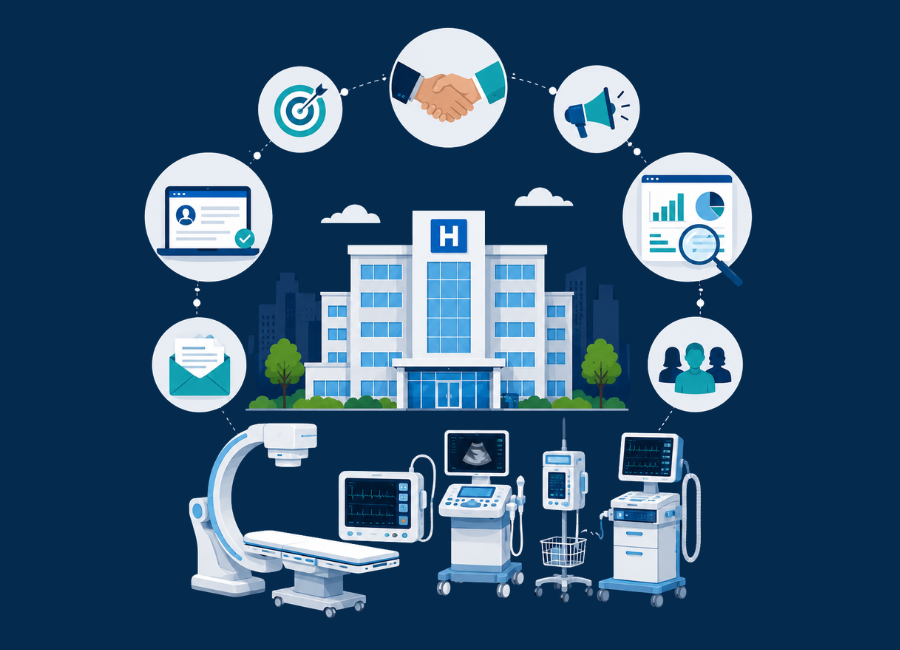
Marketing medical devices to hospitals in 2026 involves more than presenting a product to a doctor. Hospital purchases often involve clinicians, procurement teams, supply chain managers, finance departments, administrators, and value analysis committees.
This creates a challenge for medical device companies: they must reach the right people with the right message. However, a clear B2B marketing plan can help companies connect with hospital decision-makers before the buying process begins.
Effective hospital marketing combines account-based marketing, email, SEO, LinkedIn, clinical evidence, educational content, webinars, and accurate healthcare contact data. Messaging should address the distinct priorities of clinical and business audiences.
What is a Hospitals Email List?
A Hospitals Email List is a database of hospitals and healthcare professionals with business contact details such as email addresses, job titles, hospital names, and locations.
Medical device companies can use a targeted hospital email list to find the right hospital decision-makers, promote their products, generate leads, and build B2B relationships. A quality list should be accurate, updated, and relevant to your target audience.
Understanding the Hospital Buying Journey
- Need identification: A physician, nurse, administrator, or department identifies a problem requiring a solution.
- Product research: Teams research available technologies and vendors.
- Clinical evaluation: Healthcare professionals assess safety, effectiveness, usability, and patient outcomes.
- Stakeholder review: Relevant departments review the proposed technology.
- Value analysis: The organization evaluates clinical and financial value.
- Procurement review: Purchasing teams examine pricing, contracts, vendors, and supply requirements.
- Financial approval : Budget owners determine whether the purchase fits financial objectives.
- Contracting: Agreements, GPO arrangements, pricing, and terms may be negotiated.
- Implementation: Staff training, installation, integration, and onboarding take place.
- Ongoing evaluation: The hospital may measure utilization, outcomes, savings, and user satisfaction.
Best Ways to Market Medical Devices to Hospitals
1. Build a Targeted Hospital Buyer Persona
Start by defining exactly who is most likely to influence or purchase your product. Consider the type of hospital, department, specialty, geographic market, organization size, and decision-making role.
For example, a surgical technology company may target surgical directors, operating room managers, surgeons, procurement professionals, and supply chain leaders rather than marketing the entire healthcare industry.
Creating detailed buyer personas helps your sales and marketing teams develop more relevant campaigns and avoid spending resources on low-value prospects.
Turn This Guide into Your Next Campaign
2. Use Account-Based Marketing for High-Value Hospital Accounts
Account-based marketing (ABM) allows medical device companies to focus their resources on specific hospitals and health systems that have strong potential.Instead of sending the same campaign to thousands of contacts, identify priority accounts and build personalized campaigns around them.
An effective ABM campaign can combine:
- Targeted email
- LinkedIn outreach
- Search campaigns
- Personalized landing pages
- Educational content
- Webinars
- Sales follow-up
- Retargeting
For expensive or complex medical devices, ABM can be especially useful because the sales process may involve a relatively small number of high-value hospital accounts.
3. Reach Hospital Procurement and Supply Chain Decisionmakers
Medical device companies should create messaging that demonstrates:
- Cost efficiency
- Product reliability
- Supply continuity
- Vendor support
- Contract flexibility
- Product availability
- Total cost of ownership
- Implementation support
A campaign that only explains product features may not resonate with procurement professionals. Show them how the product can contribute to operational efficiency and organizational value.
4. Market Directly to Value Analysis Committees
Value Analysis Committees evaluate products from multiple perspectives, including clinical effectiveness, safety, cost, operational impact, and overall value.
Medical device companies should make it easy for these committees to evaluate their solutions by providing organized resources such as:
- Clinical studies
- Product specifications
- Safety information
- Cost analysis
- ROI information
- Implementation requirements
- Training details
- Case studies
- Customer outcomes
Creating a dedicated hospital value analysis resource page can also help potential buyers find the information they need without navigating through multiple pages.
5. Lead With Clinical Evidence and Real-World Outcomes
Healthcare buyers expect credible evidence before adopting new technologies. Product claims should be supported by appropriate clinical research, outcomes of data, customer experiences, and other credible evidence.
Instead of simply saying that a device is “innovative,” explains what makes it valuable.
For example:
- Does it improve workflow?
- Can it reduce procedure time?
- Does it support better patient outcomes?
- Can it reduce waste?
- Does it simplify staff training?
- Can it improve operational efficiency?
Evidence-based content builds credibility and gives hospital stakeholders information they can use during internal evaluations.
6. Create a Strong Hospital-Focused Medical Device Website
Essential Website Pages
- Product Overview
- Clinical Evidence
- Hospital Benefits
- Safety and Compliance
- ROI and Cost Savings
- Case Studies
- Implementation and Training
- FAQs
- Procurement Resources
- Request a Demo
SEO Elements to Include
7. Publish Educational Content for Hospital Buyers
Useful topics include:
- How to Evaluate Medical Devices for Hospitals
- Medical Device Procurement Checklist
- Hospital Value Analysis Committee Requirements
- How to Calculate Medical Device ROI
- Questions Hospitals Should Ask Medical Device Vendors
- Medical Device Implementation Guide
- Medical Technology Evaluation Process
- Medical Device Compliance Considerations
This approach can increase organic visibility while positioning your company as a knowledgeable resource.
8. Use LinkedIn to Reach Hospital Decisionmakers
Medical device companies can use LinkedIn to:
- Share educational articles
- Publish product demonstrations
- Promote webinars
- Share clinical research
- Highlight customer success stories
- Engage with healthcare leaders
- Run targeted advertising campaigns
Avoid making every post a product advertisement. A mix of educational, clinical, industry, and product content can create stronger engagement and credibility.
9. Build a Targeted Healthcare Email Marketing Campaign
Email marketing can help medical device companies maintain direct communication with relevant healthcare professionals. Instead of sending one message to everyone, segment your audience by role.
Example Segments
Procurement:
Focus on cost, contracts, reliability, and supplier support.
Clinical Leaders:
Focus on outcomes, usability, safety, and clinical evidence.
Supply Chain:
Focus on inventory, availability, logistics, and operational efficiency.
Hospital Executives:
Focus on ROI, strategic value, efficiency, and organizational impact.
10. Use Healthcare Contact Data to Improve Outreach Precision
The quality of your prospect data can directly affect the effectiveness of an outreach campaign. Medical device companies should identify contacts based on relevant job functions, healthcare organizations, specialties, geographic areas, and other targeting criteria.
A targeted healthcare database can help marketers identify professionals such as procurement leaders, supply chain executives, hospital administrators, physicians, clinical leaders, and other relevant stakeholders.
How MediColeads Can Support Hospital Marketing
MediColeads can be positioned as a data resource for companies looking to build targeted healthcare outreach campaigns.
Relevant audience segments may include:
- Hospital Procurement Email List
- Healthcare Supply Chain Email List
- Hospital Administrators Email List
- Medical Directors Email List
- Healthcare Executives Email List
- Physicians Email List
- Nursing Email List
- Medical Device Industry Email List
Use the current verified counts and available targeting fields from the relevant MediColeads database pages when publishing this section.
Common Medical Device Marketing Mistakes
- Targeting Only Physicians: Physicians are important, but many hospital purchases involve procurement, supply chain, finance, administration, and value analysis teams.
- Focusing Only on Product Features: Explain the business, clinical, and operational value of the device rather than listing specifications alone.
- Using Generic Healthcare Messaging: A procurement director and a physician have different priorities. Build role-specific messaging.
- Ignoring ROI: Hospital buyers need to understand how a product can contribute to financial and operational objectives.
- Using Outdated Contact Data: Incorrect job titles and old contact information can reduce campaign efficiency and waste sales resources.
- Measuring Only Clicks and Opens: Engagement metrics are useful, but qualified opportunities, account engagement, evaluations, and revenue are more meaningful indicators of business impact.
How to Choose the Right Hospitals Email List?
1. Know Your Target Audience
Before choosing a hospital email database, define your target audience. Filter contacts by hospital type, size, location, specialty, department, job title, seniority, and purchasing responsibility.
For example, a surgical equipment company may target procurement directors, supply chain managers, surgeons, operating room leaders, and clinical directors.
Simple tip: Create an ideal customer profile before buying a list.
2. Check Contact Accuracy
The database should contain current and relevant contact information. Ask how the provider collects, verifies, and updates records.
Find out how often the list is refreshed, how job changes are tracked, and what happens when an email becomes invalid.
Simple tip: Request a sample and verify several contacts before purchasing the full database.
3. Look for Useful Filters
A good hospital email database should allow filtering by job title, department, hospital, health system, location, specialty, seniority, and organization type.
These filters help you create separate campaigns for procurement teams, clinical leaders, executives, and other groups.
Simple tip: Choose a list that helps you send the right message to the right audience.
4. Focus on Decision-Makers and Data Quality
Evaluate a hospital contact list by its decision-maker coverage, not just its record count. Look for procurement, supply chain, clinical, physician, and finance contacts within target hospitals.
Useful fields include contact name, job title, hospital, department, location, specialty, health-system affiliation, business email, and seniority.
5. Check Freshness, Delivery, and Replacement Policies
Ask when the data was last checked and how often it is updated. Also review email verification, bounce rates, invalid-record replacement, and refund or credit policies.
Before sending a large campaign, test the list and monitor delivery results to protect your budget and sender reputation.
Simple tip: Get the replacement policy in writing before purchasing.
6. Review Compliance and Test the Provider
A verified list is only the starting point. How you use it affects whether campaigns actually reach and engage podiatrists.
How MediColeads Fits Into This Evaluation
When evaluating MediColeads or another healthcare data provider, compare data accuracy, freshness, segmentation, decision-maker coverage, and campaign fit.
MediColeads helps medical device companies reach relevant hospital contacts in procurement, supply chain, clinical, administrative, and executive roles. Its database supports targeted outreach, personalized messaging, account-based campaigns, and sales follow-up.
The goal is not simply to purchase a Hospital Email Address Database, but to identify the right hospitals and decision-makers for relevant outreach. The best database is accurate, regularly updated, well-segmented, and aligned with your ideal customer profile.
Conclusion
Marketing medical devices to hospitals in 2026 requires reaching the right hospitals and decision-makers with targeted SEO, LinkedIn, email, webinars, clinical evidence, ROI content, and sales follow-up.
A targeted Hospitals Email List can help identify relevant contacts, but success also depends on accurate data, clear messaging, useful content, strong proof, and consistent follow-up. Explore MediColeads healthcare databases to connect with key hospital decision-makers.