


TABLE OF CONTENTS
Veterinarian email address lists play a practical role in US B2B campaigns aimed at securing direct access to clinical decision-makers, practice owners, and senior veterinary professionals.
These lists are most effective when brands need targeted outreach in regulated, relationship-driven markets like pet healthcare, veterinary SaaS, and medical supplies.
US B2B marketers typically rely on veterinarian contact data when timing, relevance, and segmentation matter more than scale. Whether launching a new product, promoting education, or supporting account-based campaigns, email remains one of the few channels that allows controlled, compliant communication with veterinary practices nationwide.
This approach is most useful when teams already understand their ICP and need precision—by practice type, specialization, or geography—rather than broad awareness.
Veterinarian email list is best used when US B2B campaigns require precise access to verified veterinary decision-makers, not mass reach.
Role of Veterinarian Email Data in B2B Marketing
In B2B marketing, veterinarian email data functions as an activation layer, not a discovery tool. US marketers use veterinary professionals email databases to support targeted campaigns where personalization, relevance, and compliance are expected.
Unlike consumer lists, US veterinarian contacts are typically segmented by role (practice owner, associate vet), specialization, clinic size, and region. This allows B2B teams to align messaging with real operational needs—such as equipment upgrades, software adoption, or clinical education.
Email data also supports multi-touch strategies, where outreach is coordinated with events, sales enablement, or partner marketing. Accuracy and freshness matter because outdated records directly affect deliverability and brand trust.
Veterinarian email data enables controlled, role-specific B2B outreach when accuracy and segmentation are prioritized over volume.
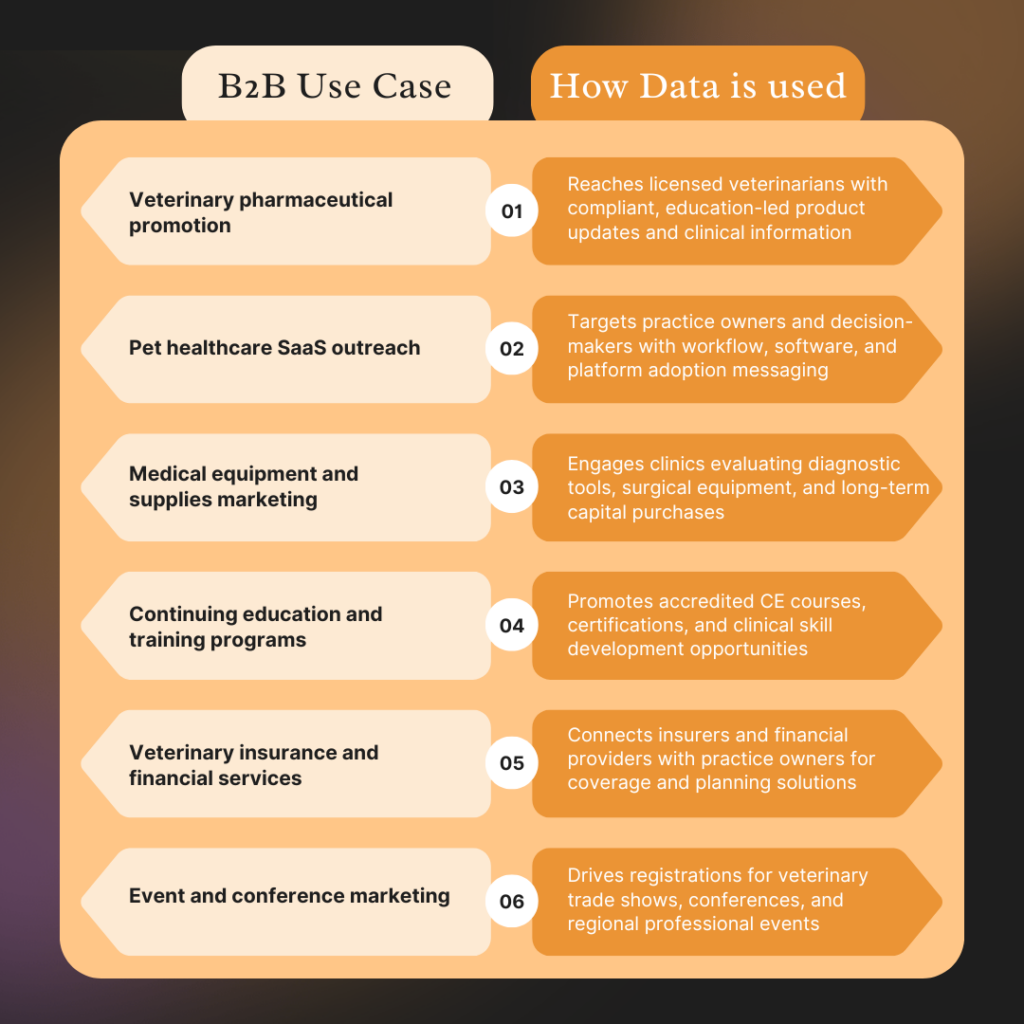
1: Promoting Veterinary Pharmaceuticals to US Clinics
This use case focuses on introducing or supporting prescription and OTC veterinary pharmaceuticals through compliant B2B communication. Pharma companies and distributors use veterinarian email address lists to reach licensed professionals responsible for treatment decisions.
Email data matters here because access must be limited to qualified veterinarians, often segmented by species focus or clinic type. US marketers prioritize validation to ensure messaging aligns with regulatory expectations and professional standards.
A common campaign angle is educational-first outreach—sharing clinical updates, product usage guidance, or formulation improvements—rather than direct promotion. This positions the brand as a resource while supporting downstream sales conversations.
Verdict: Pharmaceutical outreach works best when veterinarian email lists are used for education-led, compliance-aware communication with verified clinicians.
2: Pet Healthcare SaaS Outreach to Veterinary Practices
Pet healthcare SaaS companies use veterinarian contact data to introduce platforms that improve practice operations, client communication, or patient management. Typical users include SaaS growth teams and B2B demand marketers targeting independent and multi-location clinics.
Email matters because buying decisions often involve both veterinarians and practice managers. Segmented US veterinarian contacts allow tailored messaging based on clinic size, digital maturity, or service mix.
A realistic campaign angle is workflow-focused messaging—highlighting appointment efficiency, record access, or client engagement—without overselling features. Email acts as the entry point for demos, webinars, or trials.
Verdict: SaaS campaigns succeed when veterinarian email data supports role-aware messaging tied to real operational pain points.
3: Medical Equipment and Supplies Marketing
Medical equipment and supply vendors rely on veterinarian email addresses lists to reach clinics evaluating new tools, diagnostics, or consumables. This includes imaging providers, lab equipment manufacturers, and surgical supply brands.
Email data is critical because purchases are infrequent, high-consideration, and budget-sensitive. US B2B teams typically segment veterinarian contact data by practice size, service scope, or specialty to avoid irrelevant outreach.
A common angle is lifecycle-based messaging—maintenance reminders, upgrade windows, or new compliance standards—rather than cold product pitches. Email supports longer sales cycles and distributor coordination.
Vet marketing performs best when veterinarian email lists are segmented to align with buying cycles and clinic-level capabilities.
4: Training Programs for Veterinarians
Education providers and industry sponsors use veterinarian contact data to promote CE programs, certifications, and clinical training. The primary users are event marketers, education platforms, and professional associations.
Email matters because continuing education is mandatory in many US states, but relevance varies by specialty and license type. Veterinary professionals email databases allow precise targeting by discipline and location.
A practical campaign angle is deadline-driven reminders or topic-specific invites tied to emerging treatments or compliance updates. Clear value and accreditation details drive engagement without aggressive promotion.
Verdict: CE outreach is most effective when the veterinarian email data aligns education topics with specialty and licensure needs.
5: Veterinary Insurance and Finance Outreach
Insurance providers, lenders, and financial advisors use US veterinarian contacts to reach practice owners and senior clinicians involved in financial decisions. This includes malpractice insurance, equipment financing, and retirement planning.
Email data matters because relevance is tied to career stage and ownership status. US marketers prioritize segmentation by role, years in practice, or clinic ownership structure.
A common campaign angle focuses on risk management or operational stability—policy updates, coverage reviews, or planning resources—rather than hard-selling financial products.
Verdict: Financial services campaigns work when veterinarian email lists target ownership and decision authority, not general practitioners.
6: Industry Events and Conference Promotions
Event organizers and sponsors use veterinarian email addresses lists to drive attendance for conferences, trade shows, and regional meetups.
Users include event marketers and industry associations.
Email matters because attendance depends on timing, location, and specialty relevance. US veterinarian contacts are segmented by geography and professional focus to ensure practical value.
A typical campaign angle highlights peer learning, exposure to new technology, or CE credits. Email supports early registration, agenda updates, and post-event follow-ups.
Verdict: Event promotion succeeds when veterinarian email data is geographically and professionally aligned with the event’s value proposition.
How US B2B Teams Segment Veterinarian Email Addresses Lists
- Practice type (independent vs corporate)
- Role (owner, associate, medical director)
- Species focus or specialty.
- Geographic location
- Clinic size and service scope
Verdict: Effective segmentation turns veterinarian email lists into precision tools rather than generic outreach assets.
Compliance and Data Quality Considerations for US Campaigns
US marketers prioritize data compliance with CAN-SPAM requirements, opt-in norms, and professional communication standards. B2B teams typically validate veterinarian contact data for accuracy, recency, and relevance to the campaign before use.
Clean data supports deliverability, protects brand reputation, and reduces wasted spend. Compliance-aware workflows also help maintain trust with veterinary professionals.
Verdict: Data quality and compliance are foundational—not optional—for sustainable B2B outreach in the US veterinary market.
Common Mistakes Marketers Make with Veterinarian Email Data
Frequent mistakes include over-emailing, poor segmentation, outdated records, and generic messaging. US B2B teams also underperform when they treat veterinarian email addresses lists as lead generation shortcuts instead of relationship tools.
Ignoring role differences or practice context often leads to low engagement and unsubscribes.
Verdict: Most failures stem from misuse, not the data itself—strategy and relevance determine outcomes.
FAQs About Veterinarian Email Lists
Are veterinarian email addresses lists suitable for B2B campaigns?
Yes, when used for compliant, role-targeted outreach in industries like pharma, SaaS, and veterinary services. Relevance matters more than volume.
How do US marketers ensure data accuracy?
B2B teams typically validate veterinarian contact data through regular refresh cycles and role verification processes.
Can these lists support account-based marketing?
Yes. US veterinarian contacts are often used to map decision-makers within target accounts.
What industries benefit most from veterinarian email data?
Pharma, pet healthcare SaaS, equipment suppliers, education providers, and financial services see the strongest alignment.
Is email still effective for veterinary professionals?
When messaging is relevant, compliant, and educational, email remains a practical B2B channel.
Final Thoughts
Veterinarian email addresses lists deliver value when they support targeted, compliant, and outcome-driven B2B campaigns. The strongest results come from aligning use cases with segmentation, timing, and professional relevance.
US marketers who treat veterinarian contact data as a strategic asset—rather than a volume play—build stronger engagement and long-term relationships.
Choosing reliable data sources simply helps that strategy work as intended.
Verdict: Sustainable B2B growth in the US veterinary market depends on how intelligently email data is applied, not how often it’s used.
Contact Us