

Prosthodontists manage complex restorative and implant cases, requiring advanced materials, precise equipment, and premium digital tools. Their decisions are driven by accuracy, esthetics, workflow efficiency, and long-term patient outcomes—making sales more specialized and technically demanding.
Selling to Prosthodontists in 2025: The Ultimate Guide to Direct Access & Decision-Maker Influence

TABLE OF CONTENTS
Selling prosthodontists in 2025 presents unique challenges, but it also offers significant opportunities. Dental practices are increasingly looking for solutions that streamline operations and improve overall practice efficiency. To succeed in B2B healthcare marketing , need to understand that dentists aren’t just buying products—they’re investing in solutions that align with their practice goals.
In this guide, you’ll learn how to:
- Identify key decision-makers within dental practices.
- Understand the buying process and their decision-making criteria.
- Position your product as a solution to common dental practice pain points.
- Leverage accurate, up-to-date contact lists to target the right audience.
- Build lasting relationships that lead to repeat business.
By adopting the right approach, you can influence purchasing decisions, build trust, and drive successful sales outcomes with dentists. Let’s dive into the strategies that will set you apart in the dental market.
1. Follow These 7 Steps to Sell Medical Products/Services Successfully to Prosthodontists
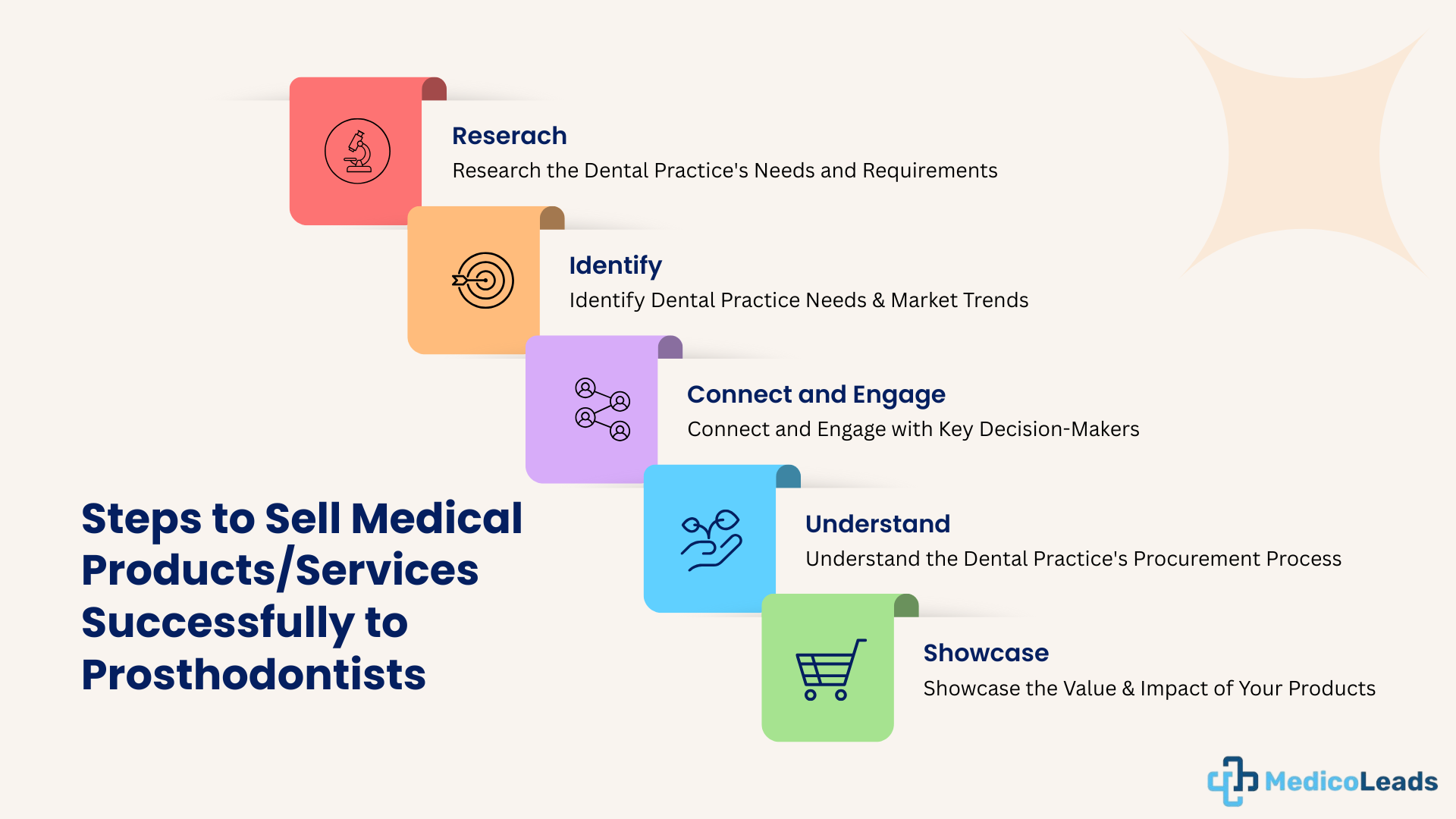
1.1. Research the Dental Practice's Needs and Requirements
The key to selling to prosthodontists is understanding their unique needs, goals, and challenges—not assuming what they might require. Every dental practice is different, with varying treatment focuses and budget constraints. Before presenting any product, gather relevant data on the practice’s operational gaps and purchasing priorities.
1.2. Identify Dental Practice Needs & Market Trends
Prosthodontists are driven by factors like improving care, enhancing operational efficiency, and staying competitive in a growing market.
To prepare:
- Review the practice’s services (e.g., geriatric prosthodontics, implant prosthodontics, maxillofacial prosthodontics)
- Identify challenges such as equipment upgrades, staff efficiency, or retention.
- Analyze trends such as the rise of implant dentistry or telehealth services.
- Understand the competitive landscape and what technologies or products competitors are adopting.
This level of preparation positions you as a trusted advisor, not just a salesperson.
1.3. Connect and Engage with Key Decision-Makers
Dental practices may be smaller than hospitals, but decisions are still made by key influencers who hold purchasing power. Typically, these decision-makers include:
- Prosthodontist/Owner: Especially in solo or small group practices, the prosthodotist is often the ultimate decision-maker.
- Practice Managers: Responsible for budgeting and day-to-day operations.
- Clinical Staff: Senior hygienists, dental assistants, and lab technicians may influence equipment decisions.
- Purchasing Coordinators: Larger practices may have dedicated staff handling procurement.
Knowing who holds the power helps tailor your outreach and approach.
1.4. Understand the Dental Practice's Procurement Process
While dental practices often have more streamlined purchasing processes than hospitals, they still require careful consideration. Key procurement elements to understand include:
- Budget Cycles: Dental practices tend to have fixed budgets, but they may set aside funds for new equipment or tech annually or quarterly.
- Leasing vs. Buying: Many practices prefer leasing over buying high-cost equipment like digital X-ray machines or chairs.
- Vendor Selection: Prosthodontists often prioritize trusted suppliers and peer recommendations over new or untested vendors.
Understanding these preferences can shorten your sales cycle and increase conversion chances.
1.5. Showcase the Value & Impact of Your Products
Dental practices prioritize clinical effectiveness, outcomes, and operational improvements. When selling to prosthodontists, it’s essential to demonstrate how your product or service will:
- Improve patient experience: Faster, more comfortable procedures.
- Enhance practice efficiency: Reduce downtime and improve staff productivity.
- Deliver a clear ROI: Whether through cost savings or higher revenue generation.
Use specific data and case studies to back up your claims. For instance:
“A dental office using our digital impression system reduced patient wait time by 30% and increased appointment capacity by 15%.”
Your value proposition must directly align with their priorities: enhancing care while running a more profitable, efficient practice.
1.6. Deliver Consistent Support & After-Sales Assistance
rosthodontists highly value after-sales support and ongoing service. Many dental buyers rank training, customer support, and product maintenance as top factors in selecting a vendor.
Your strategy should include:
- Training for staff on new products or equipment.
- Maintenance and service schedules to ensure longevity and optimal performance.
- On-demand customer support to address issues promptly.
- Regular product updates and opportunities for further clinical education.
Strong post-sale relationships build loyalty and can turn a one-time buyer into a long-term client.
1.7. Use Verified B2B Data Providers for Targeted Outreach
To quickly reach the right dental decision-makers, leveraging verified B2B data is essential. Accurate, up-to-date contact lists allow you to:
- Identify the key decision-makers (dentists, practice managers, procurement coordinators).
- Launch targeted, personalized outreach campaigns based on the specific needs of different types of dental practices.
- Reduce outreach time by eliminating unqualified leads and ensuring your message lands with the right audience.
Partnering with MedicoLeads, enables you to optimize your marketing strategy, drive better engagement, and boost sales efficiency.
Struggling to Reach the Right Dental Decision-Makers?
Targeting outdated or wrong contacts wastes time and kills conversions.
MedicoLeads provides verified dentist contacts segmented by specialty, role, and practice size—so your outreach hits the right inbox every time.
2. Industries That Sell to Prosthodontists
2.1. Dental Equipment Manufacturers
Dental equipment manufacturers play a major role in supporting prosthodontic practices, delivering essential high-value tools such as digital scanners, dental milling machines, 3D printers, CBCT systems, and advanced impression technology.
Since these devices have a direct impact on esthetics, precision, and treatment predictability, prosthodontists carefully evaluate equipment. Sellers must highlight accuracy, clinical consistency, and long-term ROI.
With recent technological advancements, prosthodontic practices prioritize technologies that enhance digital workflows, improve the patient experience, and integrate seamlessly with restorative planning software.
2.2. Dental Supply & Prosthodontic Material Vendors
Vendors that supply restorative materials—such as ceramics, zirconia blocks, bonding agents, implant components, cements, provisional materials, and impression supplies—are vital partners for prosthodontists. These clinicians rely on high-performance materials to deliver predictable, esthetic results. Reliability, shade accuracy, and quality assurance heavily influence purchasing decisions
Furthermore, vendors offering subscription-based replenishment, bulk pricing for high-volume cases, and streamlined ordering platforms earn strong loyalty from prosthodontic teams managing complex restorative workloads.
2.3. Dental Software & Digital Workflow Technology Providers
Digital technology providers sell CAD/CAM software, treatment planning platforms, smile design tools, digital occlusion systems, and cloud-based imaging solutions that power modern prosthodontic care. These tools are increasingly central to delivering premium restorative and reconstructive treatments.
Dental professionals across the USA and other countries, are favoring software that improves diagnostic accuracy, integrates with scanning and milling devices, and enables smooth collaboration with dental labs. Sellers who offer interactive demos, clinical education, and seamless onboarding stand out in the fast-evolving landscape of digital dentistry.
2.4. Dental Laboratories & Prosthetic Manufacturers
Dental labs are essential partners for prosthodontists, producing high-quality crowns, veneers, implant restorations, dentures, full-arch prostheses, and complex rehabilitative cases. Precision, communication, and turnaround time are critical for this specialty.
Prosthodontists are gravitating toward labs with advanced digital capabilities—such as model-free workflows, AI-assisted design, and integration with intraoral scanners. Labs that provide consistent esthetics, material transparency, and strong technical support build long-term, high-value relationships with prosthodontic practices.
2.5. Pharmaceutical, Biomaterial & Oral Health Product Companies
Pharmaceutical companies and biomaterial suppliers selling anesthetics, analgesics, regenerative products, implant biomaterials, tissue grafting components, and therapeutic oral-care solutions frequently work with prosthodontists. These products support complex restorative and surgical procedures.
In 2025, prosthodontists favor brands that deliver evidence-based outcomes, reliable supply chains, and clinical education. Sellers who provide product samples, CE courses, and scientifically validated data earn greater trust—especially when products directly influence patient comfort, implant success, and long-term prosthetic performance.
3. Best 10 Effective Strategies To Achieve in Dental Sales
3.1. Turn Social Platforms Into Your Dental Influence Engine
Social media has become one of the most effective ways to shape dental buying behavior. Platforms like LinkedIn, Instagram, and YouTube allow sellers to showcase clinical outcomes, workflow improvements, product demos, and expert insights.
With prosthodontists increasingly researching vendors online before replying to outreach, strong visibility helps build trust and brand authority. Consistent, educational posts position your company as the go-to resource for modern dental practices.
Action Steps
- Share quick clinical tips, case results, and demo clips
- Use LinkedIn Ads to target dentists and practice owners
- Join dental CE groups and specialty forums
- Highlight outcomes like efficiency, accuracy, and patient comfort
- Promote webinars, hands-on sessions, and product walkthroughs
3.2. Run Precision Campaigns That Attract Serious Dental Buyers
Targeted campaigns help sellers reach the right dental decision-makers with messaging tailored to specialty, practice size, and purchasing authority. Personalized campaigns outperform generic outreach by a wide margin, especially when backed by segmented email sequences and dedicated landing pages. Since prosthodontists value clarity, relevance, and efficiency, targeted campaigns help eliminate noise and bring high-intent leads directly into your pipeline.
Action Steps
- Segment by sub-specialty and practice size
- Build specialty-focused landing pages and demo offers
- Use retargeting ads for dentists who visit your website
- Design automated nurturing sequences
- Include proof through cases, ROI visuals, and practice benefits
3.3. Empower Sales With Clinically Savvy Dental Specialists
Dentists prefer sellers who understand real clinical workflows—chairsides, procedural steps, equipment needs, and client expectations. Hiring team members with dental backgrounds or strong clinical training significantly improves credibility. These specialists can explain product benefits in practice-relevant language, lead demonstrations with confidence, and support dentists in evaluating ROI. Their insights accelerate trust and reduce friction throughout the sales cycle.
Action Steps
- Recruit reps with dental or technical experience
- Provide advanced training on dental procedures and terminology
- Use experts to lead demos and live Q&A sessions
- Align messaging with realistic clinical use cases
- Develop educational content powered by expert insights
3.4. Master the Internal Decision Web of Dental Practices
Purchasing decisions in dental practices involve more people than ever: the prosthodontist, office manager, lead assistant, practice partner, and sometimes specialists. Each role prioritizes different outcomes—from clinical performance to operational efficiency and financial justification. Understanding these motivations helps tailor outreach and accelerate approvals. For higher-value products, mapping the internal decision web is essential for moving deals forward smoothly.
Action Steps
- Identify influencers: dental professionals, office manager, assistant, partner
- Customize communication for clinical, financial, and operational needs
- Understand approval paths for software vs. equipment
- Prepare documentation for financing or compliance checks
- Maintain multi-channel communication across the practice
3.5. Lead With Reliability Through Compliance and Certifications
Prosthodontists rely heavily on safety, regulatory compliance, and product accuracy. Whether selling equipment, pharmaceuticals, or digital tools, providing complete and transparent documentation builds immediate trust. Every dental professional expects vendors to deliver FDA approvals, ISO certifications, HIPAA readiness, sterilization data, and safety tests up front. Companies that demonstrate compliance early in the conversation shorten evaluation time and stand out as reliable partners.
Action Steps
- Showcase FDA, ISO, CE, or HIPAA compliance where applicable
- Share safety testing, sterilization protocols, and audit results
- Include compliance materials in proposals and demos
- Train teams on regulatory rules and patient safety standards
- Highlight verification badges in marketing content
3.6. Use Account-Based Precision to Win High-Value Dental Clients
Account-Based Marketing (ABM) enables dental sellers to target top-tier practices, multi-location clinics, and DSOs with personalized, high-impact messaging. Instead of broad outreach, ABM focuses on the accounts most likely to generate revenue. Tailored demos, specialty-specific resources, and multi-contact engagement build trust and deliver significantly higher win rates.
Action Steps
- Identify high-value practices, DSOs, and specialty clinics
- Map decision-makers across the clinical and office team
- Build custom messaging sequences for each role
- Create practice-specific demos and case studies
- Use behavior insights and intent data to time outreach
3.7. Build Predictable Revenue With Prosthodontist-Focused Email Sequences
Email marketing remains one of the most effective channels for engaging dentists, especially when the messaging highlights clinical value and operational benefits. High-performing dental email campaigns use clear, concise communication with strong proof points—such as ROI, case studies, product visuals, and time-saving outcomes. Automated sequences help nurture interest and convert prospects steadily over time.
Action Steps
- Segment lists by specialty, role, and practice size
- Create subject lines that emphasize value and clinical relevance
- Include procedural advantages, demo videos, and financial insights
- Add strong CTAs for trials, demos, or consultations
- Use automation to send timed, personalized follow-ups
Conclusion
Selling to prosthodontists requires precision, personalization, and a deep understanding of how modern practices make decisions. Dentists expect clear clinical value, seamless workflows, trustworthy compliance, and vendor partners who truly understand their day-to-day challenges. When your outreach speaks directly to their needs—supported by credible insights, targeted campaigns, and relationship-focused communication—you position your brand as a long-term solution rather than just another vendor.
As you fine-tune your strategy, having reliable access to the right dental decision-makers is essential. That’s where platforms like MedicoLeads quietly strengthen your efforts—providing accurate, specialty-based data that helps your message reach the practices most ready to engage. Combine strong strategy with smart targeting, and your dental sales success becomes far more predictable and scalable.
Emails Not Getting Responses from High-Value Dentists?
Generic lists and poor targeting slow your sales cycle and cost revenue.
With MedicoLeads, reach verified, high-intent dental buyers with precision and boost conversions fast.
FAQ
What do prosthodontists value most when evaluating new products?
They prioritize precision, material quality, digital integration, esthetic outcomes, and predictable clinical performance. Evidence-based results, hands-on demos, and strong post-purchase support are major factors influencing their choices.
How can vendors access prosthodontist decision-makers effectively?
Using verified B2B healthcare databases, specialty-focused outreach, LinkedIn engagement, and targeted email sequences helps bypass gatekeepers and reach the right prosthodontists—such as practice owners, implant specialists, and digital dentistry directors.
What marketing strategies work best for selling to prosthodontists in 2025?
Digital workflow education, clinical webinars, CE programs, product-led demos, case-study-driven content, and personalized account-based marketing deliver the best results. Strategies must showcase practical, aesthetic, and technological benefits.
Which industries typically sell to prosthodontists?
Dental equipment manufacturers, prosthetic labs, digital dentistry software providers, biomaterials suppliers, dental consumable vendors, and pharmaceutical companies all engage prosthodontists—offering tools and materials central to advanced restorative dentistry.
Contact Us