Who Offers the Best Custom Healthcare Contact Lists for US Campaigns?
HK
Harshith Kumar
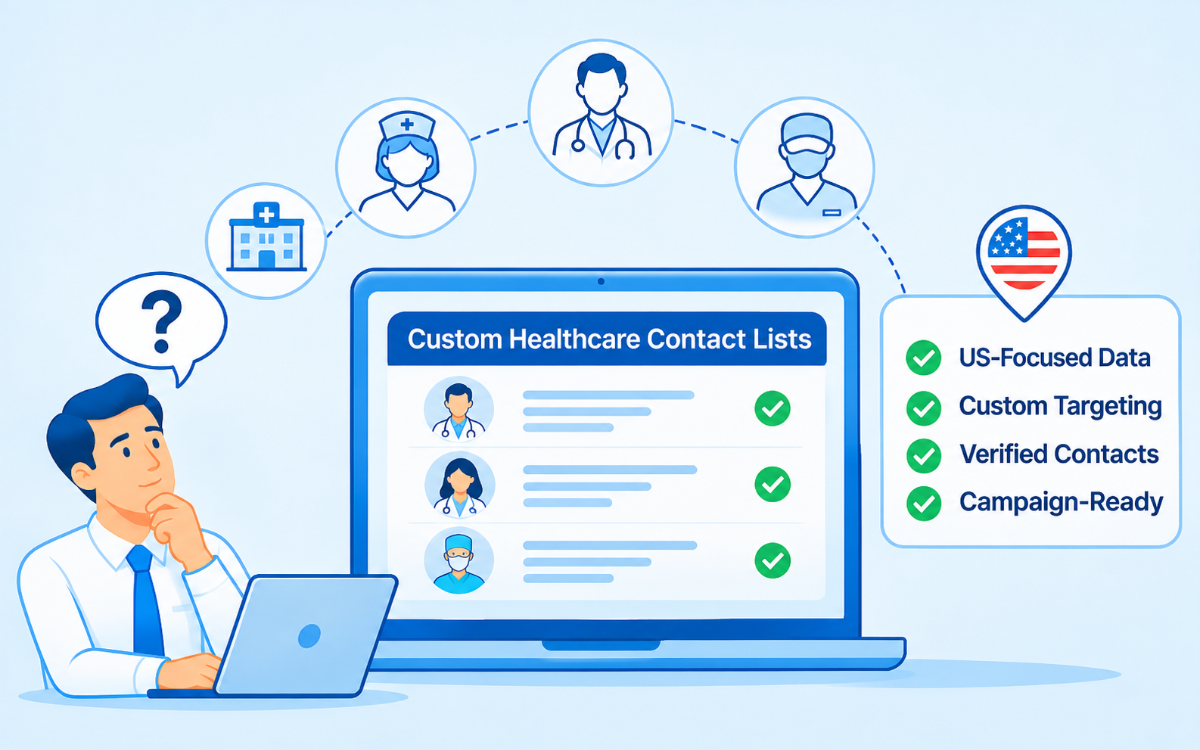
TABLE OF CONTENTS
- What is a custom healthcare contact list?
- Key takeaways
- Custom vs prebuilt: which to choose
- When a custom list is worth it
- How to write a specification
- How the build process works
- How to evaluate a provider
- Pricing and turnaround to expect
- Compliance for US campaigns
- How MedicoLeads builds custom lists
- Conclusion
QUICK ANSWER
Most healthcare data is sold prebuilt. You pick a list labelled by specialty, the provider sends a file, and you discover after the first campaign how much of it matched what you actually needed.
A custom list inverts that. You specify the segment first, the provider confirms how many records genuinely match, and verification runs against that segment rather than against a database average. For niche or multi-criteria targeting, this is usually the difference between a usable file and an expensive one.
This guide covers what custom list building involves, when it is worth the extra time, how to write a specification that gets accurate counts back, and the criteria that separate providers who build to order from those who filter a static file and call it custom.
What Is a Custom Healthcare Contact List?
Key Takeaways
- Custom means specified first, built second. If the provider filters an existing export at delivery, that is a prebuilt list with a filter applied.
- A confirmed count is the key deliverable before payment, quoted against your exact filter combination rather than the database total.
- Per-record verification dates are what let you judge freshness and plan re-verification later.
- Custom pays off for multi-criteria and niche targeting, and is usually unnecessary for broad single-specialty campaigns.
- Expect a few business days for a genuine build, not instant download.
- Compliance is yours. A vendor supplying data does not transfer CAN-SPAM responsibility to that vendor.
Custom vs Prebuilt: Which Should You Choose?
| Factor | Prebuilt list | Custom build |
|---|---|---|
|
Turnaround |
Hours, sometimes instant |
Typically 2 to 5 business days |
|
Best for |
Broad single-specialty targeting |
Multi-criteria or niche segments |
|
Count accuracy |
Estimated from database totals |
Confirmed against your exact filters |
|
Verification |
Database-wide averages |
Run against your delivered segment |
|
Field coverage |
Whatever already exists |
Gaps reported before you pay |
|
Cost per record |
Lower |
Higher, reflecting build work |
|
Main risk |
Paying for records outside your target |
Lower confirmed count than hoped |
|
Good fit when |
You need volume in a common specialty |
You sell to a specific buyer profile |
When a Custom List Is Worth the Extra Time
- Multi-criteria targeting — independent practices, in a specific specialty, under a certain size, in named states.
- Role-specific outreach — where you need decision-makers rather than every clinician in the specialty.
- Thinly covered specialties — smaller professions where prebuilt coverage varies sharply between providers.
- Account-based programmes — where you supply a target account list and need contacts mapped to it.
How to Write a Specification That Gets Accurate Counts
| Specify | Why it matters | Example |
|---|---|---|
|
Specialty, precisely |
Broad categories hide sub-specialty gaps |
Interventional cardiology, not cardiology |
|
Role and authority |
Determines whether the contact can buy |
Practice owner or clinical director |
|
Practice type and size |
Independent and system-employed differ sharply |
Independent practices with 2 to 10 providers |
|
Geography granularity |
Decides territory routing accuracy |
Named states plus metro areas |
|
Required fields |
Blank fields break segmentation |
Business email, NPI, practice address |
|
Verification recency |
Sets the quality floor you accept |
Confirmed within the last 90 days |
|
Minimum fill rate |
Protects the fields you filter by |
At least 90% on role and specialty |
|
Exclusions |
Avoids paying for suppressed records |
Exclude prior opt-outs and current customers |
24 TO 48 HOUR DELIVERY
Need a List Built to Your Exact Criteria?
How the Custom Build Process Works
- 1. Specification review. The provider restates your criteria and flags anything ambiguous or likely to return low counts.
- 2. Count confirmation. You receive a confirmed record count against your exact filter combination, not a database estimate.
- 3. Sample delivery. A small random sample from the matched segment, so you can check accuracy before committing.
- 4. Verification pass. Checks run against the matched segment specifically, with results reported.
- 5. Delivery with metadata. The file arrives with per-record verification dates and documented fill rates.
How to Evaluate a Custom List Provider
| Criterion | Question to ask | Why it matters |
|---|---|---|
|
Count confirmation |
Will you confirm counts against my exact filters? |
Separates building from filtering |
|
Sample policy |
Can I see a random sample from my segment? |
Curated samples show best records only |
|
Verification dates |
Does every record carry its own date? |
File-level claims cannot be acted on |
|
Segment freshness |
What share of my segment was verified recently? |
Database averages hide stale segments |
|
Fill rates |
What is fill rate on my filter fields? |
Sparse fields break segmentation |
|
Unresolved records |
What share could not be confirmed? |
An answer of zero is a warning sign |
|
Remedy |
What happens if deliverability falls short? |
Turns a claim into a commitment |
|
Data sources |
Where does the underlying data come from? |
Indicates coverage bias |
Pricing and Turnaround You Should Expect
Want a Confirmed Count Before You Commit?
Compliance Considerations for US Campaigns
How MedicoLeads Builds Custom Healthcare Lists
Conclusion
Frequently Asked Questions About Custom Healthcare Contact Lists
What is a custom healthcare contact list?
A B2B dataset built to a buyer-defined specification rather than sold prepackaged. You define specialty, role, practice type, geography and required fields; the provider confirms how many records match and verifies that subset before delivery. The key difference from a prebuilt file is that coverage gaps appear as a lower confirmed count before payment.
How is a custom list different from a prebuilt one?
Order of operations. A prebuilt list is selected then filtered, so you inherit existing coverage. A custom list is specified then built, so verification runs against your delivered segment rather than a database average. The practical test is whether the provider confirms a count against your exact filter combination before you pay.
How long does a custom healthcare list take to build?
Typically two to five business days for a genuine build, covering specification review, count confirmation, sample delivery, a verification pass and delivery with metadata. Instant delivery indicates filters were applied to an existing export, which may be acceptable but should be priced as a prebuilt file rather than a custom build.
When is a custom list worth the extra cost?
When your targeting takes three or more filters to describe. Multi-criteria targeting, role-specific outreach, thinly covered specialties and account-based programmes all justify it. For broad campaigns in a large, well-covered specialty where volume matters more than precision, a prebuilt file usually offers better value per record.
How much do custom healthcare contact lists cost?
Pricing is normally per record, with the rate rising for niche specialties, strict role filters and demanding fill-rate requirements, since each narrows the pool and increases verification work. Compare quotes on confirmed count and verification recency rather than headline price, because cost per usable record is the figure that matters.
What should I ask a provider before buying?
Ask whether they will confirm counts against your exact filters, whether you can see a random rather than curated sample, whether every record carries its own verification date, what share of your segment was verified recently, fill rates on your filter fields, what share could not be confirmed, and what the remedy is if deliverability falls short.
Is buying a healthcare contact list legal in the US?
Purchasing B2B contact data is generally permitted in the US, and commercial email is governed by the CAN-SPAM Act enforced by the FTC. Requirements include accurate sender information, a valid physical address, a clear opt-out mechanism and prompt honouring of requests. Responsibility sits with the sender, not the vendor. This is general information, not legal advice.
What fields should a custom healthcare list include?
At minimum: name, role, specialty, practice name, business email, practice address and geography. NPI is valuable where available because it enables reliable deduplication. Business phone and practice website are commonly included. Specify which fields you will actually filter by and set a minimum fill rate on those specifically.
Related Resources
- 7 Fields to Check Before Buying Any Healthcare Email List
- Healthcare Email List Pricing: What Top Providers Charge Per Contact
- How 7-Tier Verification Makes Physician Contact Data Reliable
- Reliable Physician Contact Data for Healthcare Marketing Teams
- How to Segment Healthcare Email Lists by Specialty and Job Role
Ready to get a list built to your specification?
- Filter by specialty, practice type and role
- Confirmed counts for your exact criteria
- Sample records before purchase
- Export formats that fit your CRM
Sources and References
ABOUT THE AUTHOR

William Coogan
FREE SAMPLE
See records from your exact segment
Popular lists
TALK TO US
Ready to Build Your Custom Healthcare List?