

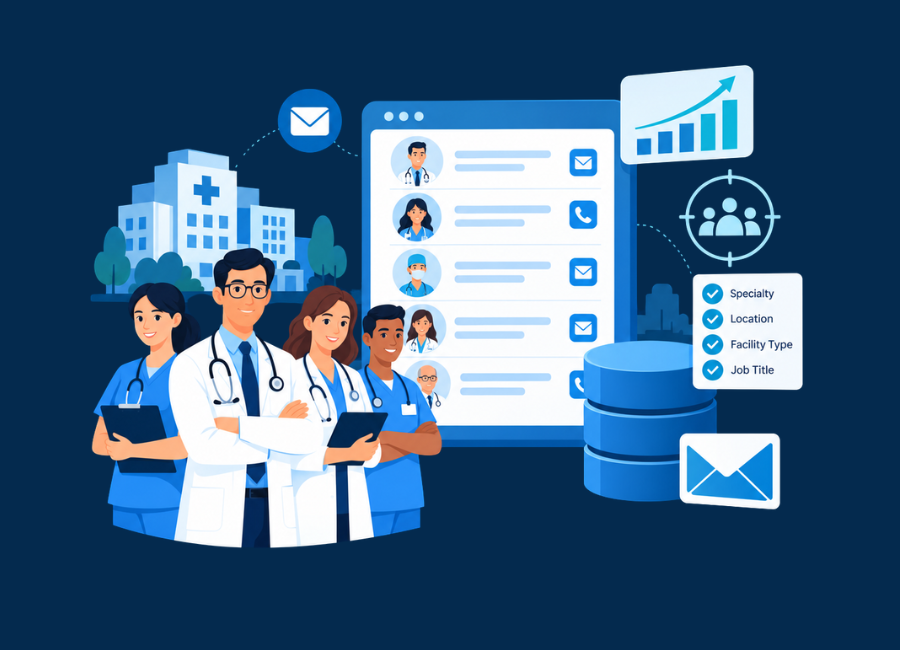
Effective healthcare email outreach starts with accurate, targeted, and up-to-date contact data. Since healthcare decisions often involve multiple professionals, a well-segmented database helps marketers identify the right contacts and build more relevant campaigns by role, specialty, organization, and location.
This guide compares five B2B data providers that healthcare teams commonly shortlist for a healthcare industry email list, separates the healthcare-native providers from the broad B2B platforms, and gives you a checklist to run before you pay for anything.
What Is a Healthcare Industry Email List?
A healthcare industry email list is a file of verified business contact records for people who work in healthcare. Each record usually carries a name, professional title, organization, business email address, and location, and may also include medical specialty, department, facility type, and firmographic details about the employer.
Field coverage is not uniform across providers. Some populate medical specialty and NPI numbers for clinical roles; others focus on corporate titles inside healthcare companies and leave specialty blank. Fill rate matters as much as record count, so ask which fields are actually populated for the segment you want rather than which fields the platform supports. For a fuller breakdown, see what a healthcare email list includes. One point is worth stating plainly: this is business contact data, not patient data, and the two should never be conflated.
What Should You Look for in a Healthcare Email List Provider?
Most buyers compare providers on database size first. That is the least useful number available. A file of two hundred thousand irrelevant contacts performs worse than four thousand correctly targeted ones. Score providers on the factors below instead, and read the fields worth checking before you buy.
| Evaluation Factor | What to Check |
|---|---|
|
Data accuracy |
What the figure measures and how it was tested, not just the headline percentage |
|
Email verification |
The steps each record passes before it ships, and whether business emails are validated |
|
Data freshness |
How often records are revalidated and what triggers an out-of-cycle update |
|
Healthcare coverage |
Whether your exact roles, specialties and facility types exist in usable volume |
|
Specialty segmentation |
Filtering at clinical specialty level, not only by industry code |
|
Geographic targeting |
Country, state, metro and postal-level selection for your markets |
|
Job-title targeting |
Seniority, department and decision-making role, clinical and non-clinical |
|
Company-level data |
Employer name, facility type, size and firmographics attached to each contact |
|
Customization |
Whether a file can be built to your criteria when no standard segment fits |
|
CRM compatibility |
Export formats, field mapping, deduplication and enrichment of existing records |
|
Compliance |
How data is collected, how consent and opt-outs are handled, what use is permitted |
|
Support |
Targeted samples, pre-purchase consultation and a replacement policy for bad records |
No provider scores top marks on every row. Decide which three factors matter most for your campaign and weight the comparison accordingly.
Top 5 B2B Data Providers for Healthcare Industry Email Lists
One of these providers builds its data around healthcare audiences. The other four are broad B2B platforms with healthcare segments inside a much larger database. That distinction drives most of the difference in how the resulting lists behave.
| Provider | Healthcare Coverage | Segmentation | Verification / Data Quality | Best For |
|---|---|---|---|---|
|
Healthcare professionals, specialties & organizations |
Specialty, job title, organization, geography |
Automated + manual verification; CRM-ready |
Specialty-level healthcare lists |
|
|
Healthcare contacts within a broad B2B database |
Job title, seniority, industry, company |
Verification, staffing & technology alerts |
Sales & org-chart targeting |
|
|
Healthcare contacts across hospitals, clinics & networks |
Specialty, location, facility & B2B filters |
Continuous verification & enrichment; CRM-ready |
Self-serve prospecting |
|
|
International B2B healthcare coverage |
Industry, title, seniority, geography, intent |
Manual + automated checks; ISO 27001 & SOC 2 |
International prospecting |
|
|
Healthcare companies & contacts |
Firmographics, location, size & intent |
Dun & Bradstreet data with AI scoring |
Company & firmographic research |
1. MedicoLeads
MedicoLeads is a healthcare-focused B2B data provider with 1M+ physician contacts, 2M+ nurse contacts, and 14M+ healthcare contacts across multiple professions and specialties. Its coverage is organized by healthcare profession and medical specialty rather than generic industry codes. Segments such as physicians, nurses, dentists, pharmacists, surgeons, and medical directors can be targeted directly rather than filtered from a broader business database.
Lists can be built by medical specialty, job title and seniority, organization type, facility size, and geography across U.S. and international markets. Verification combines AI-powered checks with manual review, while data is revalidated every 45 days and delivered CRM-ready. Custom files can also be built when no standard segment matches the audience.
Typical use cases: medical device and healthcare SaaS outreach, pharmaceutical account-based campaigns, clinical recruitment, and agency campaigns that need a defined specialty audience rather than a general business list.
2. ZoomInfo
ZoomInfo is a broad B2B sales intelligence platform, and healthcare is one segment inside it. Its published healthcare directory reports coverage including more than 230,000 companies, 6 million direct emails, 4 million direct dials and 84,000 C-level contacts across hospitals, health insurers, pharmaceutical companies and medical organizations.
The strengths are org charts, job-title targeting and alerting on staffing, funding and technology changes, which suits teams selling software or services into healthcare organizations. Filtering is firmographic and title-based, and the data connects into most common CRM and sales stacks.
Consideration: targeting is built around corporate structures rather than clinical taxonomy, so segmenting by medical specialty is weaker than with a healthcare-native provider.
3. Apollo
Apollo.io is a broad B2B sales intelligence and engagement platform, with healthcare contacts available across hospitals, clinics, medical practices, and other healthcare organizations. Its overall database includes 275M+ contacts, while the healthcare-specific estimates in this comparison include approximately 310K+ healthcare companies, 7M+ direct emails, 2.8M–3.2M direct dials, and 65K–72K C-level contacts.
Its strengths include contact filtering, email verification, sales engagement, CRM integration, and automated outreach, allowing teams to segment healthcare prospects by job title, specialty, location, company, and other attributes.
Consideration: Apollo does not publicly publish fixed healthcare-specific counts for these categories, so the healthcare figures should be treated as estimates rather than official Apollo-published totals.
Turn This Guide into Your Next Campaign
4. Cognism
Cognism is a B2B data provider with a strong European and international presence alongside U.S. coverage. Its estimated healthcare coverage includes 120K–140K companies, 3.2M–3.5M verified business emails, 1.1M–1.4M direct dials, and 42K–48K C-level contacts across healthcare organizations and senior decision-makers.
Its strengths include phone-verified mobile numbers, verified business emails, compliance-focused data, and regular data updates. Cognism also provides technographics, hiring and funding signals, and intent data through Bombora to help teams identify and prioritize relevant accounts.
Consideration: Cognism primarily targets healthcare through industry and job-title filters rather than detailed clinical specialty taxonomy, making it more suited to company-level healthcare prospecting than highly specific clinician-level campaigns.
5. D&B Hoovers
D&B Hoovers is a company intelligence platform built on the Dun & Bradstreet data cloud. It reports access to data on more than 330 million companies and contacts, with buyer intent data, news triggers, AI-powered prospect scoring and CRM enrichment for systems such as Salesforce.
For healthcare, its strength is organization-level research: identifying hospital groups, medical device manufacturers, pharmaceutical companies and healthcare service providers, then understanding corporate family trees, size and location before outreach begins.
Consideration: it is firmographic-first. If your campaign targets individual clinicians by specialty, you will need a healthcare contact source alongside it.
Which Healthcare Email List Provider Is Best?
The right provider depends on your campaign goals and targeting needs. Match the provider to the job you are hiring it for.
- Best for healthcare-focused list building: MedicoLeads, because specialty, role and facility targeting is built around clinical audiences.
- Best for broad B2B prospecting: Apollo, because database, filtering and outreach sit in one workflow.
- Best for sales intelligence: ZoomInfo, because org charts, titles and change alerts support complex healthcare buying committees.
- Best for international prospecting: Cognism, because of its European coverage, phone-verified mobiles and DNC screening.
- Best for company and firmographic research: D&B Hoovers, because corporate structures, scoring and CRM enrichment are its core.
Many teams end up using a healthcare-native provider for clinician-level campaigns and a broad platform for company research, rather than forcing one tool to do both.
How to Evaluate a Healthcare Industry Email List Before Buying
- Contact relevance. Confirm the records match the people who make or influence the decision, not merely the right industry.
- Healthcare specialization. A healthcare-native file carries clinical attributes a general business file does not.
- Business versus personal email coverage. B2B outreach belongs on business addresses; personal addresses raise deliverability and compliance risk.
- Verification process. Ask for the specific steps a record passes, not a headline accuracy figure.
- Data freshness. Healthcare data decays quickly as clinicians move, so ask how often records are revalidated.
- Segmentation. Check that specialty, job title, department and facility type combine in one query.
- Geographic coverage. Verify depth in your target countries and states, not just that the country is listed.
- Compliance. Understand how the data was collected, how opt-outs are handled and what use is permitted.
- Sample testing. Request a sample built to your exact criteria and check it against sources you trust.
- CRM compatibility. Confirm export format, field mapping and deduplication against records you already hold.
Our guide to choosing a healthcare contact data provider walks through each step in more detail.
Common Mistakes When Buying Healthcare Email Lists
- Choosing on contact volume alone, which rewards the largest file rather than the most relevant one.
- Ignoring data freshness and inheriting contacts who left their employer months ago.
- Skipping the sample, then discovering field gaps after the invoice is paid.
- Failing to check professional relevance, so the file reaches healthcare organizations but not the roles that buy.
- Ignoring segmentation and sending one message to an audience that spans five specialties.
- Assuming every address is verified because the provider uses the word verified.
- Not reviewing applicable privacy and marketing laws for each market you are sending into.
- Buying a generic business list when a targeted healthcare list is what the campaign actually needs.
How Businesses Use Healthcare Industry Email Lists
- Healthcare SaaS: reaching practice managers, clinical directors and IT leaders at organizations matching a target profile.
- Medical device companies: targeting surgeons, procurement leads and department heads by specialty and facility type.
- Pharmaceutical companies: account-based programs aimed at specific therapeutic areas and prescriber groups.
- Healthcare recruiters: building candidate and client pipelines across clinical roles and regions.
- Medical marketing agencies: assembling campaign-specific audiences on behalf of healthcare clients.
- Healthcare technology vendors: promoting EHR, telehealth and revenue-cycle products to the relevant decision-makers.
- Research organizations: recruiting clinical participants, survey respondents and advisory board members.
How MedicoLeads Supports Healthcare B2B List Building
MedicoLeads builds contact data around healthcare audiences rather than adding a healthcare filter to a general business database. Targeting works at the level teams actually plan campaigns: medical specialty, job title and seniority, organization type, facility size and geography, across United States and international markets.
Records pass through a verification process that combines automated validation with manual review, and lists arrive CRM-ready with fields mapped so they load without reformatting. Custom files can be built to campaign-specific criteria when a standard segment does not match the audience, and ready-made specialty lists cover audiences such as pharmacists, dental practices and hospital decision-makers alongside the wider healthcare email list.
If you want to judge fit before committing, requesting a sample built to your exact criteria is the fastest way to see how a segment behaves.
Best Practices for Using a Healthcare Email List
- Segment before outreach so each specialty or role receives a message written for it.
- Personalize with fields you have verified, such as specialty and organization, rather than guessed attributes.
- Validate contacts with an email verification service before the first send.
- Use business contact details for business purposes, and keep clinical and commercial communication separate.
- Maintain suppression lists and honor every opt-out immediately across all campaigns.
- Respect applicable privacy and marketing regulations, including the CAN-SPAM Act in the United States and EU data protection law where it applies. This is general information, not legal advice; confirm your obligations with your own counsel.
- Monitor bounce rates, complaint rates and engagement, and pause sending if bounces climb.
- Revalidate periodically, because healthcare contact data decays faster than most B2B segments. Our notes on keeping healthcare contact data clean cover the cadence.
Ready to Connect with the Right Healthcare Audience?
Frequently Asked Questions
What is a healthcare industry email list?
A healthcare industry email list is a file of verified business contact records for healthcare professionals and healthcare organizations. Records typically include name, professional title, organization, business email address and location, and often medical specialty, department and facility type. It supports B2B sales, marketing and recruitment outreach, and contains business contact information rather than patient information.
Where can I buy a healthcare email list?
Healthcare email lists are sold by healthcare-focused data providers such as MedicoLeads and by broad B2B platforms such as ZoomInfo, Apollo, Cognism and D&B Hoovers. Healthcare-native providers usually offer deeper specialty segmentation and custom list building, while general platforms offer wider firmographics and built-in prospecting tools. Request a sample for your exact criteria before buying from any of them.
What should a healthcare email database include?
At minimum: contact name, professional title, organization, verified business email and location. Useful additions are medical specialty, department, facility type, organization size and firmographic details about the employer. Fill rate matters more than the field list, so ask what share of records in your chosen segment actually carries each field you plan to use for targeting or personalization.
How do I choose a healthcare email list provider?
Score providers on healthcare coverage for your exact roles and specialties, verification method, revalidation frequency, segmentation depth, geographic reach, customization, CRM readiness and compliance handling. Then ask for a targeted sample, load it into your CRM, check the fields you intend to personalize with, and run a small test send before committing to a full file.
Are healthcare email lists legal to use?
Business-to-business email marketing to healthcare professionals is generally permitted where it follows applicable law. In the United States that means the CAN-SPAM Act rules on accurate headers, sender identification and opt-out. In Europe the GDPR governs the handling of personal data. Requirements differ by country and channel. This is general information, not legal advice; confirm your obligations with counsel.
How can I verify healthcare email addresses?
Ask the provider what verification the file has already passed, then run your own validation before sending. Use a reputable email verification service to remove invalid and risky addresses, send to a small sample first, monitor bounce and complaint rates, and suppress anything that hard bounces. Revalidate periodically, because healthcare contact data decays as clinicians change employers.
Can healthcare email lists be segmented by specialty?
Yes, with healthcare-focused providers. Specialty segmentation lets you target cardiologists, oncologists, dentists, pharmacists or nurse practitioners separately rather than emailing a general healthcare audience. Broad B2B platforms usually segment by industry and job title, which reaches healthcare organizations well but is less precise at clinical specialty level. Confirm specialty filtering on a sample before you buy.
Related Resources
Final Thoughts
Choosing a healthcare industry email list comes down to three questions. Can the provider reach the roles and specialties you sell to? Can it explain how those records were verified and how recently? Can it hand you the file in a form your CRM will accept? Healthcare-native providers tend to win on specialty depth and clinical roles; broad B2B platforms win on firmographics, org charts and workflow.
Contact volume is the easiest number to compare and the least predictive of results. A smaller, correctly segmented, recently verified file will outperform a large generic one on deliverability, reply rate and pipeline. Test with a sample before you scale.
Want to see how a healthcare industry email list looks for your exact audience? Contact the MedicoLeads sales team to request a sample built to your specialty, role and geography criteria.