

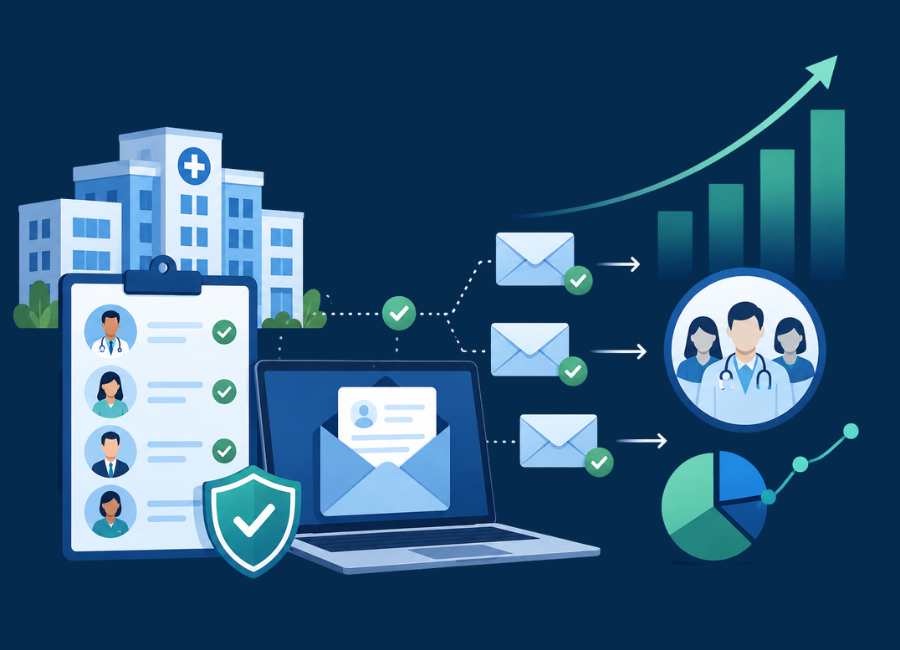
Many hospital outreach campaigns underperform for a simple reason: the contact data behind them is outdated, incomplete, or too generic to reach the right person. A sales rep emails a “Director of Purchasing” title that no longer exists at that facility. A marketing team invites “hospital administrators” to a webinar using a list built before three of those hospitals merged into a larger health system. The offer and messaging might be solid, but the campaign stalls because the data was working against the team from the start.
Hospital Email Lists that are verified and properly segmented change the conditions a campaign runs on. They help teams reach more relevant contacts, reduce invalid records in a send, personalize outreach by role and facility type, and measure results with more confidence. None of this guarantees a reply, a meeting, or a sale — those outcomes still depend on offer relevance, timing, messaging, and follow-up. Better data simply removes some of the friction that keeps a good offer from reaching the right healthcare decision-maker.
What Is a Hospital Email List?
A Hospital Email List is a business-to-business contact database containing professional email addresses, phone numbers, and organizational details for people who work at hospitals — administrators, department heads, procurement staff, clinical leaders, IT decision-makers, finance teams, and other relevant stakeholders. It supports B2B outreach such as sales prospecting, recruitment, event invitations, and vendor communication. It is not a directory of patients and contains no medical records or protected health information.
Why Weak Hospital Contact Data Hurts B2B Campaigns
Direct answer: Outdated or generic hospital contact data increases invalid sends, weakens targeting, and wastes sales time.
When a hospital outreach list hasn’t been reviewed recently, campaigns tend to run into the same problems:
- Invalid or inactive email addresses that bounce on send
- Job titles that no longer match the person’s current role
- Contacts listed under the wrong hospital after a merger
- Duplicate records that inflate list counts and skew reporting
- Generic inboxes (info@, admin@) instead of named decision-makers
- Contacts outside the department the offer is relevant to
- Missing fields that make segmentation and personalization difficult
The result: wasted follow-up time, higher bounce exposure, and reports that don’t reflect what a well-targeted list could have delivered.

What "Verified" Should Mean in a Hospital Email List
“Verified” should describe an ongoing process, not a one-time claim. A meaningful approach typically includes email validation to catch invalid addresses, checks on job titles and hospital affiliation, duplicate removal, phone and location checks where available, and periodic re-checks since hospital staff and organizational structures change over time. Some providers combine automated validation with manual review for higher-value records.
No verification method is infallible — people leave roles, hospitals merge, and email systems get restructured. Buyers should ask any provider directly about update frequency, validation methods, accuracy expectations, and what happens if a batch of contacts turns out to be inaccurate.
How Verified Hospital Email Lists Support Better Campaign Results
When a list has gone through real verification and segmentation, it tends to support:
- Better audience relevance, with fewer contacts outside the intended role or facility type
- Lower exposure to invalid addresses that would otherwise bounce
- Stronger segmentation by department, seniority, and organization profile
- More contextual personalization, since accurate titles and facility details are available
- More efficient sales follow-up, because reps spend less time on dead contacts
- Clearer performance measurement, since results reflect targeting rather than list decay
- Better alignment between an offer and the roles most likely to care about it
- More focused territory planning and account-based marketing
These are conditions that support better execution — not outcomes a list can guarantee on its own. A verified hospital contact database still needs a relevant offer and solid messaging behind it.

Segmenting Hospital Contacts for More Relevant Outreach
Direct answer: Hospital data can be segmented by role, department, facility type, size, and geography, letting a campaign speak to a narrower, more relevant audience instead of one generic list.
Common segmentation options include:
- Job title, department, and seniority level
- Hospital type (acute care, teaching, specialty, long-term care)
- Independent hospital versus multi-location health system
- Hospital ownership (nonprofit, for-profit, government)
- Organization size, employee count, and bed count where available
- Geographic location — state, city, ZIP code, or region
A message built for a 40-bed independent hospital rarely fits a 900-bed academic medical center, and a pitch aimed at an IT director looks different from one aimed at a procurement lead. Segmentation makes it possible to write for one audience instead of all of them at once.
Which Hospital Decision-Makers Should You Target?
The right contact depends on what’s being offered. Relevant roles include CEOs, CFOs, CIOs, Chief Medical/Nursing Officers, COOs, administrators, procurement and supply-chain directors, IT and clinical informatics leaders, HR and talent acquisition teams, marketing and finance leaders, department heads, facilities managers, pharmacy and lab directors, and quality/compliance leaders.
A medical device sale might route through procurement and a clinical department head, while an IT infrastructure pitch is more likely to reach an IT director. Not every campaign needs a C-suite executive — a department-level contact is often closer to the actual buying decision.
Personalizing Outreach With Hospital Contact Data
Personalization works best when it’s built on accurate, professionally relevant information: referencing the recipient’s actual role, matching the offer to their department, adapting messaging to hospital type and size, and adjusting the call to action based on what that person is responsible for. A procurement director, a clinical informatics lead, and an HR manager at the same hospital are unlikely to respond to identical messaging.
This kind of personalization should stay accurate and professional — it works because the underlying hospital decision-maker contacts are correctly labeled by role, not because of any personal or sensitive information about the individual.
How Verified Data Supports Email Deliverability
Removing known invalid addresses, separating generic inboxes from named contacts, monitoring hard bounces, and using suppression lists all reduce the damage bad data can do to a sending domain. Authenticating the domain (SPF, DKIM, DMARC) also matters.
A verified list is not, by itself, a guarantee of inbox placement. Deliverability also depends on sender reputation, message content, complaint rates, and recipient engagement. Verified data lowers one source of risk; it doesn’t remove every variable in the equation.
Practical Use Cases for Hospital Email Lists
Matching the offer to the department that owns the decision matters more than list size: medical device promotions routed to clinical department heads and procurement; healthcare SaaS outreach aimed at IT directors and CIOs; staffing campaigns aimed at HR teams; conference invitations sent to relevant clinical departments; and revenue-cycle or supply-chain solutions aimed at finance and facilities teams.
Measuring Campaign Performance by Segment
Better data quality makes campaign measurement more honest. Useful metrics include delivery rate, hard-bounce rate, reply rate, meeting-booked rate, and unsubscribe/complaint rate. Open rate is worth tracking but has become a weaker signal since privacy features in major email clients affect how it’s recorded.
The more useful comparison is rarely “how did the whole list perform,” since a Hospital Email List usually spans several hospital types, departments, and regions. Comparing performance by segment shows which audiences are actually responding, and that can inform how the next campaign is built.
What Data Fields Are Included in a Hospital Contact Database?
A customized hospital contact database can include full name, professional email, phone number, job title, department, seniority level, hospital name and health-system affiliation, facility type and ownership, address, city, state, ZIP, employee size, bed count where available, specialty or service line, and last verification date. Not every record contains every field — availability varies by geography, role, and source. A buyer evaluating a customized hospital database should ask which fields are populated for their segment, rather than assuming a full data set.
Generic Hospital Data vs. Verified, Segmented Hospital Email Lists
| Comparison Point | Generic or Outdated Hospital Data | Verified & Segmented Hospital Email Lists |
|---|---|---|
|
Email validity |
Higher share of inactive or bounced addresses |
Regularly checked against known invalid records |
|
Job-title relevance |
Often outdated after role changes |
Reviewed against current role information |
|
Hospital affiliation accuracy |
May reflect mergers or closures inaccurately |
Checked against current facility records |
|
Department targeting |
Limited or unavailable |
Filterable by department and function |
|
Geographic targeting |
Broad, hard to narrow |
Filterable by state, city, or region |
|
Duplicate control |
Higher risk of repeated records |
Actively de-duplicated |
|
Personalization potential |
Limited by missing or stale fields |
Supported by more complete, current fields |
|
Campaign measurement |
Harder to interpret, mixed with bad data |
Easier to segment and compare fairly |
|
Sales follow-up efficiency |
More time lost on invalid contacts |
Less time lost chasing dead records |
|
Customization options |
Minimal |
Filterable by role, facility type, size, geography |
|
Update transparency |
Often unclear or unstated |
Should be disclosed by the provider |
|
Compliance evaluation |
Rarely documented |
Should be discussed with the provider directly |
This is a practical comparison, not a guarantee — a verified list still needs a relevant offer and sound strategy to convert into results.
What to Evaluate Before Choosing a Hospital Email List Provider
Before purchasing, assess: data-source transparency, verification process, update frequency, sample availability, customization options, geographic coverage, available fields, accuracy expectations, replacement policy, delivery format and CRM compatibility, turnaround time, usage terms, and compliance documentation.
Risks and Limitations to Keep in Mind
No hospital contact database can guarantee campaign success. Professional contacts change roles and hospital networks merge and reorganize. A verified contact may still have no interest in the offer, and deliverability depends heavily on sender behavior and message quality, not the list alone. Compliance obligations vary by region, and purchased contact data should not be treated as consent for every channel or message type.
How MedicoLeads Supports Hospital Contact Data Requests
MedicoLeads works with healthcare marketers, recruiters, sales teams, medical device and pharmaceutical vendors, hospital technology providers, and agencies that need a hospital marketing database built around specific targeting criteria rather than one undifferentiated list. Customization can include job-title and department targeting, geographic filters, hospital-type segmentation, and CRM-friendly delivery formats, with sample data available before a full order.
MedicoLeads does not claim that any list guarantees leads, replies, or revenue, and does not present compliance as automatic simply because a list was purchased. Teams evaluating options can request a sample Hospital Email List based on their target roles, facilities, and locations.
Final Recommendation
Verified Hospital Email Lists can improve the conditions a campaign runs on: fewer invalid contacts, more relevant segmentation, more accurate personalization, and clearer measurement. They are one part of a larger campaign, not a substitute for offer relevance, message quality, sending practices, compliance, or follow-up. Before buying, request a sample, confirm which fields are populated for your segment, and ask about update frequency and replacement policy.
Frequently Asked Questions
Can I request a customized Hospital Email List?
Yes. Providers such as MedicoLeads can build a verified healthcare email list around specific criteria — job title, department, hospital type, facility size, and geography — rather than selling one fixed list to every buyer.
How much does a verified Hospital Email List cost?
Pricing typically depends on list size, the level of customization, and how narrow the targeting criteria are. Most providers quote pricing after understanding the specific roles, facility types, and regions a buyer needs, so it’s worth requesting a quote based on your actual criteria rather than comparing generic price points.
Can I review a sample before purchasing hospital contacts?
Reputable providers typically offer sample data so buyers can check field coverage, formatting, and relevance before committing to a full order. Reviewing a sample is one of the more reliable ways to judge whether a provider’s data fits your campaign.
Which data fields are included in a hospital email database?
Common fields include name, professional email, phone number, job title, department, hospital name, facility type, location, and organization size. Field availability varies by record, so it’s worth confirming which fields are populated for the specific segment you’re ordering, not just what’s listed as possible.
Can hospital contacts be segmented by job title and department?
Yes. Segmentation by job title, department, seniority, hospital type, and geography is one of the main advantages of a customized hospital contact database over a single generic list, and it’s usually what makes targeted messaging possible in the first place.
How often is the hospital contact database updated?
Update frequency varies by provider and data source. Since hospital staff and organizational structures change regularly, it’s reasonable to ask any provider directly how often records are revalidated and what triggers an update between full refreshes.
Which delivery formats are available for hospital contact data?
Most providers deliver data in common formats such as CSV or Excel, with some offering direct CRM-compatible exports. Confirming delivery format and CRM compatibility before purchase avoids formatting work later.
Can a Hospital Email List be imported into a CRM?
In most cases, yes — hospital contact data delivered in a standard format can typically be imported into common CRM and marketing platforms. It’s worth checking field-mapping compatibility with your specific CRM before finalizing a purchase.
What accuracy and replacement terms should buyers check?
Ask about the provider’s accuracy expectations, how invalid records are handled after delivery, and whether there’s a replacement policy for contacts that bounce or turn out to be outdated. These terms matter more than a single accuracy percentage on a landing page.
How should Hospital Email Lists be used for compliant B2B outreach?
Hospital Email Lists should be used for legitimate business-to-business communication, with attention to applicable regional email laws (such as CAN-SPAM, GDPR, or CASL), clear sender identification, and a working opt-out process. Purchasing a list doesn’t create consent for every channel or message type, and buyers should apply their own legal and compliance review rather than relying on a provider’s marketing claims.
Related Resources
- Hospital Email List — the main landing page for customized hospital contact databases
- Hospital Decision-Makers Email List — verified contacts for hospital CEOs, CFOs, CMOs, and administrators
- Healthcare Executives Email List — broader executive-level contacts across healthcare organizations
- Data Compliance in B2B Marketing: A Complete 2026 Guide — an overview of GDPR, CCPA, CASL, and CAN-SPAM considerations for B2B data use
- How Verified Data Fixes Healthcare Lead Generation Issues — a closer look at how data quality affects healthcare campaign outcomes
- Best Hospital Email List Providers in 2026 — a comparison of hospital contact data providers