

Reaching healthcare professionals has become one of the biggest challenges in B2B marketing. Hospital systems are larger, buying committees are more complex, and healthcare decision-makers receive hundreds of marketing messages every week. Companies that rely on generic outreach often struggle with low response rates and wasted ad spend.
In 2026, successful healthcare marketers use a combination of verified healthcare contact data, personalized email outreach, LinkedIn engagement, webinars, events, and account-based marketing to connect with the right audience. The goal is not to send more messages. The goal is to reach the right healthcare professionals with relevant information at the right time.
This guide explains the most effective strategies for healthcare technology companies, medical device manufacturers, pharmaceutical organizations, healthcare SaaS providers, staffing firms, and healthcare service companies that want to build qualified B2B pipeline.
Why Healthcare Outreach Is Different in 2026
Healthcare professionals are not a single audience. Successful B2B healthcare marketing begins by identifying the right decision-makers based on your product or service. Different stakeholders evaluate solutions from different perspectives, so your messaging should reflect their priorities.
For example, physicians often focus on patient outcomes and clinical efficiency, while hospital executives prioritize operational performance and return on investment. IT leaders look for security, interoperability, and system integration, whereas procurement teams evaluate pricing, vendor reliability, and compliance.
Instead of marketing to everyone, create segmented campaigns for the healthcare professionals most likely to influence the buying decision.
| Audience | Primary Interest | Best Outreach Channel |
|---|---|---|
|
Physicians |
Clinical outcomes |
Email, Webinars |
|
Nurses |
Workflow efficiency |
Email, LinkedIn |
|
Hospital Executives |
ROI & Growth |
ABM, Email |
|
IT Leaders |
Security & Integration |
LinkedIn, Webinars |
|
Procurement |
Pricing & Compliance |
Email, Meetings |
Healthcare professionals are more likely to engage with educational content than with direct sales pitches. Webinars allow companies to demonstrate expertise while collecting qualified healthcare leads.
- Topics that perform well
- Reducing administrative burden with automation
- Improving clinical workflows
- Revenue cycle optimization
- Healthcare cybersecurity
- AI in healthcare operations
- Regulatory compliance updates
Promote webinars through your Healthcare Industry Email List, LinkedIn, partner organizations, and industry communities. After the event, send follow-up resources and schedule conversations with engaged attendees.
Healthcare Buying Decisions Involve Multiple Stakeholders
Unlike many B2B industries where a single decision-maker approves purchases, healthcare buying decisions typically involve multiple departments. A software platform, medical device, or staffing solution may be evaluated by clinicians, IT teams, procurement specialists, compliance officers, finance departments, and executive leadership before a final decision is made.
Because each stakeholder has different priorities, marketers should avoid generic messaging. Tailored content for each audience improves engagement and supports account-based marketing strategies.
| Stakeholder | What They Evaluate |
|---|---|
|
Physicians |
Clinical value |
|
Nurses |
Ease of use |
|
IT |
Security & Integration |
|
Procurement |
Vendor comparison |
|
Finance |
Cost & ROI |
|
Executives |
Business impact |
Why Healthcare Outreach Is Different in 2026
Healthcare is not a typical B2B market. A single purchase decision may involve clinicians, procurement teams, finance leaders, IT departments, compliance officers, and executive leadership. Healthcare buying cycles are often longer and involve multiple stakeholders across hospitals and health systems.
This means marketers must focus on targeted outreach rather than broad, mass campaigns. The most successful teams build segmented audiences based on factors such as specialty, job title, facility type, geography, and organization size to deliver more relevant messaging and improve engagement.
Key takeaway: Healthcare professionals respond better to highly relevant messaging than to broad industry-wide promotions. Segmentation is often the biggest driver of campaign performance.

Start with a Verified Healthcare Email List
For most B2B healthcare companies, email remains the highest-converting outreach channel. A Healthcare Email List gives marketers direct access to physicians, nurses, hospital executives, clinic administrators, and other healthcare decision-makers.
Modern Healthcare Email Database providers offer segmentation by:
- Medical specialty
- Job title and department
- Hospital or clinic type
- Geographic region
- Organization size
- Technology adoption
- NPI or professional credentials
Using a Healthcare Professionals Email List allows marketing teams to create targeted campaigns instead of sending the same message to every contact. For example, a medical device company launching a cardiology product should target cardiologists, catheterization lab managers, and hospital procurement teams rather than the entire healthcare industry.
Best practice: Prioritize providers that regularly verify contacts, update records frequently, and support specialty-level segmentation. Data quality has a direct impact on deliverability and campaign ROI.
Use LinkedIn for Relationship Building
LinkedIn remains one of the best channels for building trust with healthcare decision-makers. Instead of immediately pitching a product, focus on becoming a valuable industry resource.
Effective LinkedIn tactics
- Share healthcare market insights and research.
- Comment on posts from hospital leaders and clinicians.
- Publish short educational articles.
- Invite prospects to webinars and virtual events.
- Use personalized connection requests.
A strong LinkedIn strategy works especially well when combined with a Healthcare Mailing List. Email can drive awareness, while LinkedIn helps build familiarity and credibility over time.
Host Educational Webinars
Healthcare professionals are more likely to engage with educational content than with direct sales pitches. Webinars allow companies to demonstrate expertise while collecting qualified leads.
- Topics that perform well
- Reducing administrative burden with automation
- Improving clinical workflows
- Revenue cycle optimization
- Healthcare cybersecurity
- AI in healthcare operations
- Regulatory compliance updates
Promote webinars through your Healthcare Industry Email List, LinkedIn, partner organizations, and industry communities. After the event, send follow-up resources and schedule conversations with engaged attendees.
Create a Multi-Channel Outreach Strategy
| Stage | Channel | Goal |
|---|---|---|
|
Awareness |
LinkedIn |
Build visibility |
|
Education |
Blog |
Build trust |
|
Engagement |
Email |
Start conversations |
|
Consideration |
Webinar |
Demonstrate expertise |
|
Decision |
Meeting |
Discuss solutions |
No single communication channel consistently reaches every healthcare professional. Combining multiple touchpoints creates greater visibility while allowing prospects to engage through the channel they prefer.
An effective outreach strategy may begin with a personalized email, followed by LinkedIn engagement, webinar invitations, educational content, and strategic follow-up. Each interaction should provide value rather than repeating the same promotional message.
Attend Healthcare Conferences and Events
Digital outreach is important, but healthcare remains relationship-driven. Industry events help marketers meet decision-makers face-to-face and accelerate trust.
Before an event:
- Build a target account list.
- Identify attendees by specialty and role.
- Schedule meetings in advance.
- Send personalized introductions.
After the event:
- Send follow-up emails within 48 hours.
- Share relevant resources discussed during the meeting.
- Connect on LinkedIn.
- Add contacts to segmented nurture campaigns.
This approach turns event conversations into measurable pipeline opportunities.
Build an Account-Based Marketing Program
Many healthcare purchases are made by organizations rather than individuals. Account-based marketing (ABM) focuses on high-value hospitals, health systems, payer organizations, and large physician groups.
A simple healthcare ABM framework
Identify
Target Accounts: Select hospitals, health systems, clinics, or payer organizations that match your ideal customer profile.
Map
Stakeholders: Identify executives, clinicians, IT leaders, procurement teams, and operational decision-makers involved in the purchase.
Engage
Multi-Channel Outreach: Coordinate email, LinkedIn, webinars, direct mail, and sales outreach around the same target account.
A Healthcare Contacts Database is often the foundation of ABM because it helps teams identify multiple stakeholders within the same organization.
Create Content for Every Healthcare Stakeholder
One mistake many marketers make is using the same message for every audience. Clinicians, executives, and IT leaders care about different outcomes.
| Audience | Primary Concern |
|---|---|
|
Physicians |
Clinical efficiency and patient outcomes |
|
Nurses |
Workflow and staffing challenges |
|
IT |
Integration, security, and compliance |
|
Hospital Executives |
ROI and operational performance |
|
Procurement Teams |
Cost, contracts, and vendor reliability |
Segmenting your Healthcare Marketing Database by role allows you to deliver messaging that feels relevant instead of generic.
Measure What Actually Matters
Instead of focusing only on email open rates, healthcare marketers should track metrics that reflect campaign effectiveness and business impact.
- Deliverability: Aim for an inbox placement rate of 95% or higher.
- Response Rate: Target a 3–8% response rate for well-segmented outreach campaigns.
- Qualified Meetings: Measure the number of meaningful conversations and meetings booked with the right decision-makers.
- Pipeline Contribution: Track opportunities generated and their impact on the sales pipeline.
- Revenue Attribution: Evaluate how marketing campaigns contribute to closed deals and overall revenue.
High-performing teams measure success by connecting campaign performance directly to pipeline growth and revenue, rather than relying solely on engagement metrics such as email opens.
Common Outreach Mistakes to Avoid
Avoid these common healthcare marketing mistakes
- Buying unverified data: Outdated contacts increase bounce rates and damage sender reputation.
- Sending the same message to everyone: Physicians, nurses, executives, and IT leaders have different priorities.
- Leading with a sales pitch: Educational value usually performs better than immediate product promotion.
- Ignoring compliance requirements: Healthcare outreach must follow applicable privacy and marketing regulations.
- Failing to follow up: Many healthcare deals require multiple touchpoints over several months.
The 2026 Healthcare Outreach Playbook
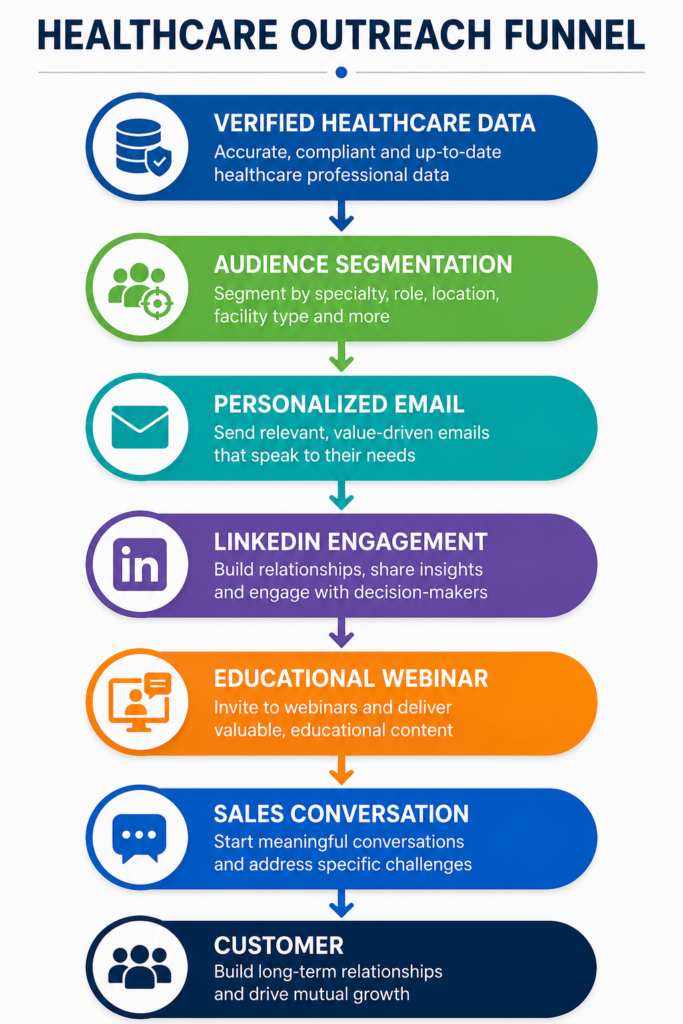
If you are building pipeline in the healthcare industry, start with this sequence:
Build a segmented Healthcare Email List
- Prioritize verified healthcare data, specialty-level data.
- Launch personalized email outreach
- Focus on role-specific messaging.
- Engage prospects on LinkedIn
- Build familiarity before asking for meetings.
- Invite contacts to educational webinars
- Create value-first engagement opportunities.
- Use ABM for strategic health systems
- Coordinate sales and marketing around target accounts.
Track meetings and pipeline, not just opens
Measure revenue impact from outreach programs.
Conclusion
Reaching healthcare professionals in 2026 requires more than a generic marketing campaign. The organizations generating the best results combine verified healthcare contact data, personalized outreach, LinkedIn engagement, educational content, webinars, and account-based marketing into a coordinated strategy.
Whether you are promoting healthcare software, medical devices, staffing services, or consulting solutions, the most effective approach is to start with a Healthcare Email Database that allows precise segmentation by specialty, role, and organization type. From there, build a multi-channel outreach program focused on relevance, education, and long-term relationship building.
Healthcare buyers are still willing to engage with vendors. They simply expect outreach that understands their role, their challenges, and the complexity of healthcare decision-making.
FAQs
What is the best way to reach healthcare professionals for B2B marketing?
The most effective approach combines a verified healthcare email list, LinkedIn engagement, educational webinars, and account-based marketing. Multi-channel outreach typically performs better than relying on a single channel.
Why is segmentation important in healthcare marketing?
How often should healthcare contact data be updated?
Healthcare organizations frequently experience staffing changes. Many leading data providers refresh and verify records every 30–90 days to maintain accuracy and deliverability.
Is email still effective for healthcare outreach in 2026?
Yes. Email remains one of the highest-performing B2B healthcare channels when campaigns use verified data, role-based segmentation, and personalized messaging.